


A Raleigh resident for 34 years and a proud homeowner in the historic Glenwood-Brooklyn neighborhood for 24, Roy Attride has been a dedicated neighborhood leader for many years. With a 22-year career in engineering including more than 7 years as a business leader before transitioning into the nonprofit sector in 2021, Roy Attride brings a balanced, solutions-driven perspective to community advocacy.
Passionate about fostering a successful, vibrant, and growing Raleigh, Roy advocates for thoughtful development that engages neighborhoods, supports smart transit and housing solutions, and ensures growth benefits all of Raleigh—not just a select few. Through Livable Raleigh, Roy shares insights, ideas, and advocacy for a Raleigh that thrives through collaboration, inclusivity, and sustainable progress.
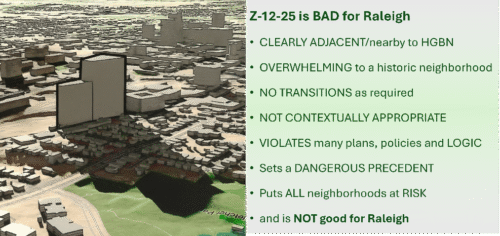
We are reprinting this article from Raleigh Neighbors United (RNU). Z-12-25 is the proposed 360 foot tower on West Street.
Proximity, Transitions, Neighborhoods and Precedent:
Why Z-12-25 Fails Raleigh’s Vision and Must Be Scaled Back
Roy Attride (Raleigh Neighbors United)
The debate over rezoning case Z-12-25 is not about whether Raleigh should grow. It is about how we grow and whether our city will uphold its own planning framework, respect its historic neighborhoods, and avoid precedents that undermine livability across Raleigh. At the heart of this case are questions of appropriate height, proximity, neighborhood protections, and precedent.
When Raleigh’s 2030 Comprehensive Plan (2030CP) and Equitable Transit-Oriented Development (ETOD) guidance are taken together, the message is clear: growth must be context-sensitive, transitions are not optional, and historic neighborhoods are a scarce and irreplaceable resource that deserve active protection.
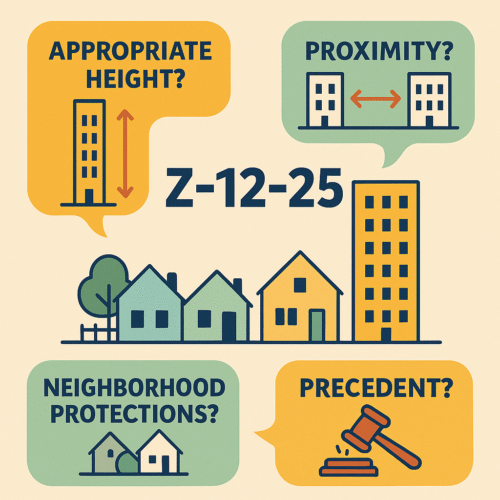
Allowing 240–360 foot, 24 and 27 story towers just 240 feet from homes and the Historic Glenwood-Brooklyn Neighborhood (HGBN) would run counter to both the letter and spirit of our adopted plans.
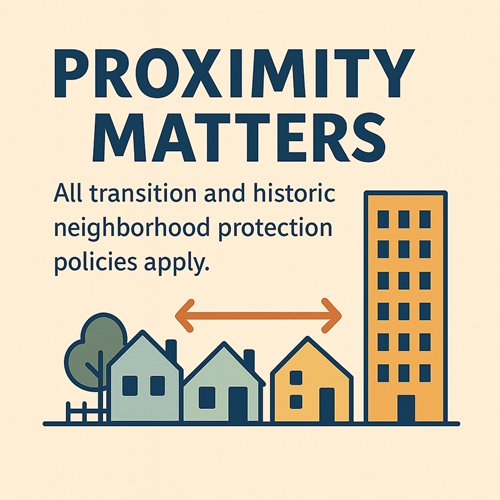
Proximity Matters
Policy analysis confirms that HGBN is nearby/adjacent to the rezoning site. Additionally, it is only 45 to 90 feet outside the 150-foot Edge condition, which limits height to four stories. This is nearby and close proximity by any reasonable definition, which means that all transition and historic neighborhood protection policies apply.
Height Guidance in Policy and Practice
Height Is Always Contextual
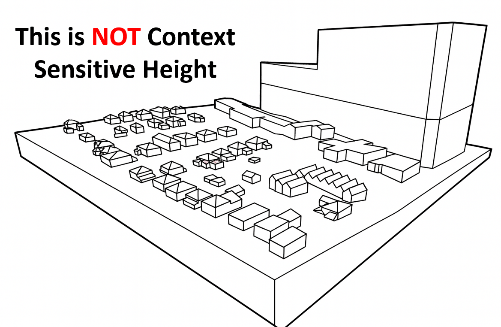
The Comprehensive Plan’s LU-2 policy states: “Appropriate building heights will vary based on context, and the appropriate height provided through future zoning actions should be determined based on site-specific characteristics and with reference to the relevant Comprehensive Plan Policies.” Context here includes adjacency to a historic district, proximity to homes, and the fact that the site sits on a raised elevation—all factors requiring moderation, not maximization.
Transition Policies Are Fundamental
The 2030CP and ETOD provide no support for jarring juxtapositions of scale. Instead, they emphasize transitions to avoid adverse impacts.
Policies such as DT 1.12 Downtown Edges require “Appropriate transitions in height, scale, and design should be provided between Central Business District land uses and adjacent residential districts.” Urban planning best practices suggest a slope of 30°–45° for height transitions—guidance that would allow 144 feet/12 stories within 250 feet (½block), reaching maximum height in ~800 feet (1½ blocks).
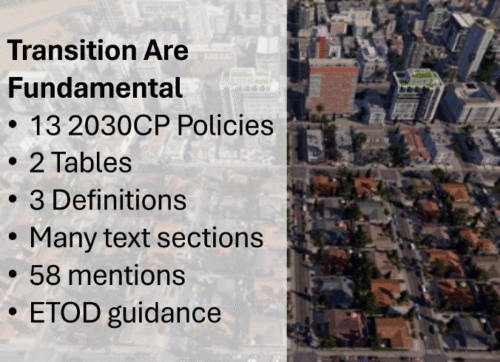
By contrast, approving 240 feet and 360 feet/24 and 27 stories within 240 feet of homes collapses the carefully designed Edge → General → Core transition framework of the 2030 Comp Plan into a single default, erasing transitions and ignoring the logic of balanced growth.
ETOD Guidance Is Explicit
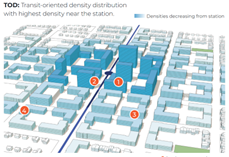
ETOD states plainly: “Density does not simply translate to taller buildings but more importantly a compact urban form” and “transition building height and bulk downward from the station to connect with adjacent, lower density districts and neighborhoods.” Growth around transit is encouraged—but always in a neighborhood-sensitive context.
Mischaracterizations in the Staff Report
The Staff Report incorrectly treats the rezoning site as part of a Core, Transit and Transit Station Area designation. These assertions fail policy and logical evaluation:
Core: The site is not within a mixed-use center core of 30 acres or more, as required. Mixed-use centers cannot be fabricated by cobbling together transit overlays. If such mischaracterizations stand, 75% of Raleigh could suddenly qualify as “mixed-use center,” stripping away meaningful planning distinctions. Logically the location is far from the core of any mixed-use area.
Transit: The Peace Street corridor lacks the infrastructure required for “high-capacity transit.” Existing frequent bus service does not meet the definition. Transit is present, but transition policies and contextual guidance still govern this location, pointing to moderation, and around 144 feet/12 stories as appropriate.
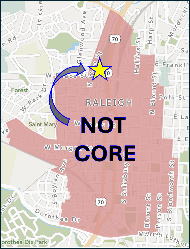
Transit Station Area: The Northern Corridor BRT Major Investment Study is incomplete. Station locations are not defined, and no station area planning has been done. Declaring this a station area is premature and inconsistent with policy. If the Northern Corridor advances in the future, this location could fall within a transit station area; even then, transition policies and contextual guidance govern, making 144 feet/12 stories the appropriate height. Even if the site were designated Core/ Transit or a Transit Station Area,
both the 2030CP and ETOD mandate that height be contingent on context and transitions. Maximizing height in this location directly violates these requirements and logical guidance for height.
Protecting Historic Resources and Neighborhoods
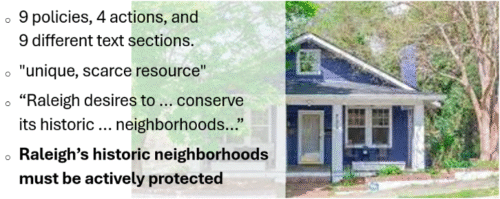
Raleigh’s Comprehensive Plan is explicit: historic neighborhoods like HGBN are “unique, scarce resources” and “one of Raleigh’s major assets.” Policies such as HP 2.7 require development proposals to identify and mitigate negative impacts on adjacent historic sites. These protections are not secondary considerations but central to Raleigh’s long-term vision.
Towering development without transition would cast shadows, create glare, and overwhelm the character of HGBN. Respecting context means reducing excessive height, limiting impacts, and ensuring transitions that protect livability.
Conclusion: Growth With Balance
Raleigh needs growth, but growth must be responsible. The 2030CP and ETOD establish a framework where context, transitions, and neighborhood protection guide how and where height happens. Z-12-25 proposes 240-360 feet/24–27 story towers just steps from a historic neighborhood. This is inconsistent with adopted plans, sets a dangerous precedent, and undermines Raleigh’s planning tools. A moderate approach, such as 144 feet/12 stories
with appropriate transitions would provide density while protecting neighborhoods and honoring Raleigh’s long-term vision for a vibrant, livable city.
Roy Attride, Raleigh Neighbors United
For more information and analysis go to RaleighNeighborsUnited.com and see:
Opposition Overview: Policy & Logic
Executive Summary Analysis of Z-12-25 Staff Report
The neighbors support the current zoning which allows for 12 stories.
12 stories IS DENSITY
12 stories provides needed housing
NOTE from Livable Raleigh – Mayor Cowell says she is keeping track of her email on the issue of the proposed 30-story tower at West St. If you are opposed to it and want to see Raleigh honor the Comprehensive Plan as Mayor Cowell said we should, then please email the Mayor and ALL the City Council to express your concerns. This email address will send your message to all council members: citycouncilmembers@raleighnc.gov or you can find complete contact information for each councilor and their social media accounts here: City Council Contacts
Stop Z-12-25 West St Tower – Sign the Petition
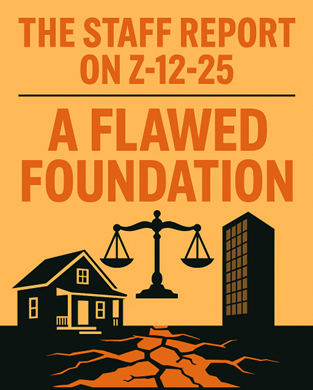
A Flawed Foundation for Deliberations
4 Easy Steps to Analyze Z-12-25
Putting Your Thumb on the Scale is Wrong!
Z-12-25 Fails Raleigh’s Three-Layer ReZoning Test
Growth with Consequences Risk to Neighborhoods
A Threat to Every Raleigh Neighborhood
Height Without Transition Risks Raleigh’s Future
The Impact of Cherry-Picking Policy – Part One
The Impact of Cherry-Picking Policy – Part Two
The Impact of Cherry-Picking Policy – Part Three
The Impact of Cherry-Picking Policy – Part Four
Is West St in the Core of Downtown?
Do City Plans have a Use By Date?
West St Tower Violates Raleigh Downtown Plan
West St Tower Violates Equitable Transit Development
West St Tower Violates the Capital Blvd Corridor Study
West St Tower Proposal Violates the Comprehensive Plan
West St Tower Neighborhood Meeting – All Stand!
Want to know more about these signs?
If you appreciate the kind of reporting we bring to you
|
Please donate $10 or $20, Thanks for supporting |
 |