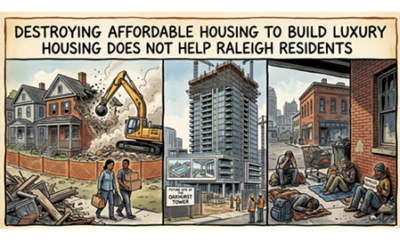
Why does “the greater good” so often require loss from the same communities? Why are the people who already rely on transit the ones most at risk of being displaced from it? What does it mean to build a transit corridor that the current riders might no longer be able to afford to live near? if the greater good keeps requiring that the same communities lose everything, perhaps we need to ask ourselves what “good” really means.
It’s time to step back and evaluate if Raleigh’s growth framework is being applied as intended.
Neighborhood Conservation Overlay Districts were adopted as legislative tools to guide growth while preserving established neighborhood patterns. If the City believes these overlays require revision, that conversation should occur through a comprehensive, citywide process—not through the incremental removal of protections on individual parcels.
Developer Welfare
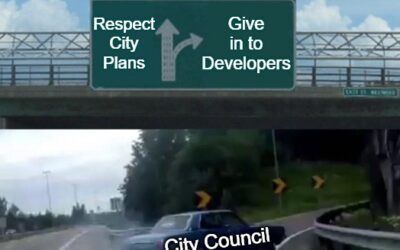
Raleigh adopted a carefully thought-out and comprehensive rezoning of the entire City just 10 years ago which was and is designed to handle the growth we are now experiencing. But, Raleigh incentivizes speculators and hustlers to find cheaper and less densely zoned land not in the core of downtown and then rezone it because the city will rezone almost anything so long as you commit to building more density whether affordable or not.
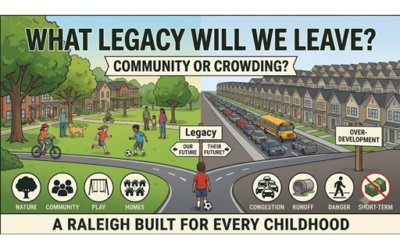
Growth is inevitable, it doesn’t have to be destructive
Growth is inevitable, it can be transformative; it’s up to us to see that it isn’t destructive. Zoning and land use planning are the tools we use to meet this challenge.
Why Hide the Truth About Raleigh’s Affordable Housing Crisis?
Some City Councilors are tireless boosters of discredited supply-side affordability theories: They cheer when the market ticks up , and they cheer even more when the market ticks down.
Raleigh’s Affordable Housing web pages are Unnavigable
Navigating Raleigh’s affordable housing webpages feels like a frustrating maze. There’s good information, unfortunately, it’s buried under confusing web design, esoteric labels, scattered across too many disconnected pages or missing altogether in outdated reports.
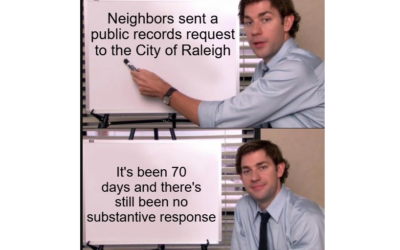
Help Hold the City Accountable
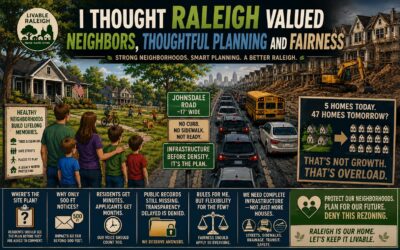
The City is approving rezonings that directly contradict its own Comprehensive Plan and Small Area Plans, the documents meant to protect neighborhoods, historic areas, and responsible growth. When the government fails to follow its own rules, residents are left with no choice but to stand up and defend themselves.
CITY COUNCIL TO MIDTOWN: DROP DEAD
It turns out that at that January hearing when North Hills traffic was lightly discussed, the referral to the Transportation Committee – which had been previously promised to opponents – was not for any review of North Hills traffic at all but rather for the Six Forks Corridor Project – a dead project that would have provided little if any relief for traffic congestion in North Hills.
Place a moratorium on new zoning change requests
Raleigh’s current plans provide ample opportunity to reach Raleigh’s housing and density goals without threatening the character that makes Raleigh such a desirable address.
Zoning consistency is foundational to confidence in land-use policy
The King Charles NCOD was adopted to preserve Raleigh’s first planned subdivision east of downtown. Neighborhood Conservation Overlay Districts are legislative commitments. They represent a balancing of growth and preservation through deliberate policy. Their credibility depends on predictability. If an overlay can be removed parcel-by-parcel when redevelopment pressure rises, its long-term stability becomes uncertain.