
Speaking for Raleigh’s Trees
We all know that trees improve our quality of life, and our environment. They clean our air, provide shade and wildlife habitat, and capture global-warming carbon. The City says it will plant 24,000 trees soon. That’s wonderful. But did you know that the carbon stored in one large old tree equals that of 1,000 young trees that are ten feet tall? So cutting down 24 large old trees equals this whole planting project!
November 17, 2026 Raleigh City Council Meeting
Highlights from 11/17/26 Raleigh City Council meeting
Filtering Isn’t a Housing Affordability Strategy in North Carolina, or Anywhere Else
Reeves Peeler builds on a widely publicized article by Strong Towns leader Chuck Marohn who argues that new housing can make rents lower than they otherwise would have been, but that is not the same as producing homes people can afford. Peeler agrees that more housing supply is needed for a growing population, but that the root cause of unaffordability is our nation’s rising income/wealth inequality, not a lack of housing supply. Peeler’s data show that despite housing supply keeping up with population in Wake County, total rental cost burdens for Wake County residents have exploded. He concludes, like Marohn, that focusing on supply will not bring about the needed widespread affordability our nation requires in order to lower homelessness, raise health and education outcomes, and ensure every American can lead a prosperous life.
November 10 City Council Meeting
Highlights from Work Session and Public Comment Session
November 4 City Council Meetings
Highlights from November 4 meetings
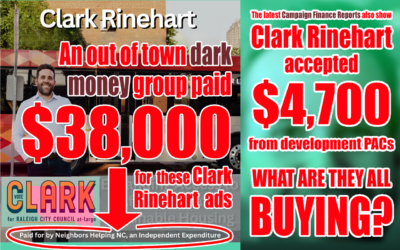
Clark Rinehart receives HUGE additional sums from the development industry
The latest finance reports filed at the end of October provide us with some shocking numbers to add to our previous reporting. Clark Rinehart received HUGE additional spending support from the development community.
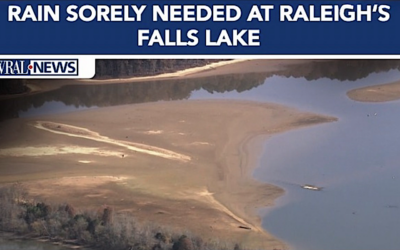
Despite Repeated Severe Droughts and a Record High City Budget, Raleigh Still Can’t Produce an On-time, Credible Water Supply Plan.
An independent analysis of this data suggests that Raleigh and Wake County may lack the long-term water supply necessary to sustain their current rate of population and economic growth. Slowing growth should be seriously considered because it is doubtful that conservation measures alone can provide the water needed if growth and water demand continue on their current trajectory.
Raleigh must demonstrate it can deliver projects already promised
Raleigh has legitimate transportation needs, and I support responsible investment in roads, sidewalks, and safety. But the City should first provide a transparent accounting of the 2017 bond, demonstrate better project-cost and schedule management, and explain the expected benefits of the proposed spending. I’m not against transportation improvements. I am against approving another $101.5 million before the City has made a sufficiently convincing case for how it will spend the money and deliver the promised results.
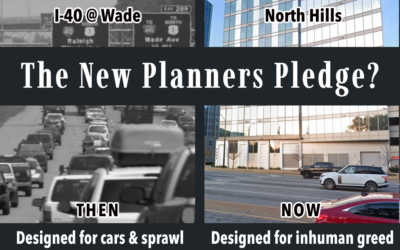
When Will City Planners & City Councilors Learn From Their Mistakes?
The Planners Pledge is a serious document, including a formal apology for the role planners played in creating the most inhospitable elements of our cites, including car dependent sprawl and its host of toxic environmental and health maladies. For those who resisted the legions of planning professionals and their transportation cohorts, the newly-discovered wisdom of designing cities for people and not cars has come much too late and has been replaced by a new and equally pernicious monetization of our lives.
Unfortunately, the planning profession’s old mantra of suburban mobility planning under the influence of the automobile industry has been replaced with a new mantra of density everywhere, under the influence of corporate real estate financialization.
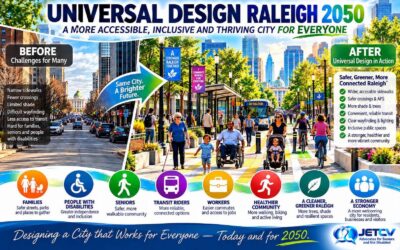
This is the power of Universal Design
What if Raleigh had an opportunity to become a national leader in accessibility, safety, and inclusion by adopting Universal Design as a citywide policy? The goal is not simply to meet the minimum requirements of the Americans with Disabilities Act. It is to create a city where accessibility, safety, and inclusion are considered from the very beginning of every project rather than after problems have already occurred.