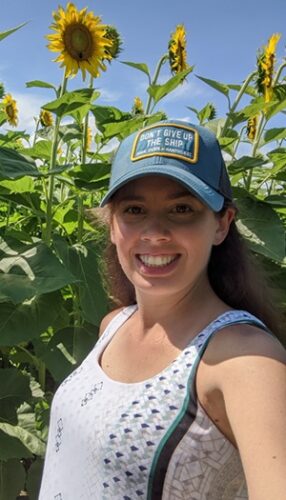
Larissa Greene is passionate about protecting the kind of neighborhood where children can safely play outdoors, families know their neighbors, and mature trees and open spaces contribute to a strong sense of community. She spends her free time walking, biking, and enjoying Raleigh’s parks. Her professional strength in building a following began in retail sales management at our Crabtree Valley Mall. Today, she uses those skills to gather community voices. For Larissa, this effort has never been about opposing change for the sake of it. It is about protecting a place people proudly call home and preserving the childhood experiences that cannot be rebuilt once they are lost. Most likely, she is outside enjoying Raleigh’s neighborhoods until the street lights come on.
Larissa spoke to City Council on July 7, 2026:
Good evening,
I am here again to state my opposition to Z-43-25.
A healthy neighborhood is a vital resource.
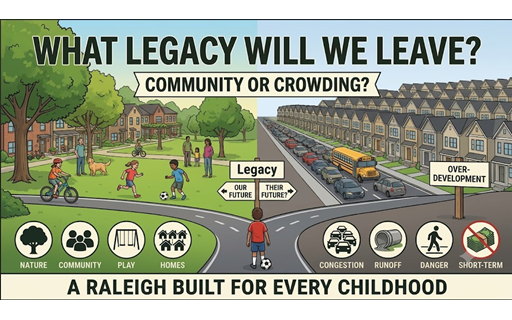
There is something priceless about the childhood many of us remember–the freedom to ride bikes until the streetlights came on, to chase lightning bugs, climb trees, and laugh with neighbors long after dinner.
Today, that way of life is increasingly rare. It is unique. It is sought after.
Families search for places where children can still experience the simple gift of growing up outdoors and build their confidence through everyday adventures. Neighbors help shape resilient, independent, and compassionate adults.
When a community succeeds, it builds a legacy that our elected city council ought to protect.
While growth is necessary for Raleigh, it should not come at the expense of any community’s well-being.
I look up many site plans and see a concerning focus on short-term profit over livability—no yards, without internal sidewalks, inadequate driveways, insufficient common areas, and a lack of safe pedestrian access to basic amenities. High-density housing requires complete infrastructure, including storm water control, crosswalks, transit benches, and parking plans. Raleigh must build a complete city, not just approve houses to go up. Why are we packing 10 extra houses into space that should be used for the residents to actually live and build community amongst each other. A garden, a playset, a dog run, a lawn, a forest, a pond for turtles, a community clubhouse, a pool, a complete street that serves the function of the traffic use.
Why are ALL of these things being cut out of communities in exchange for maximizing density profits? Raleigh is subjecting these future construction projects to limited community access, allowing neighborhoods to be built at a disadvantage by design.
I am here to protect my existing neighborhood but also help forge success for our new neighbors. Show us how 47 units will function on 3.79 acres in a healthy way for the school community, the new residents and the existing homes.
If we allow development to prioritize profits over community, our neighborhoods will fail. People are coming to petition from all over the city making comments about the city growth affecting trees, street parking, overwhelming density projects, historic neighborhoods, demolition of affordable homes, and poorly designed traffic calming.
Something is seriously wrong with the balance we are supposed to maintain. This is the 19th & 20th Public Comment speech delivered for Z 43 25. Should we be suspicious if compliant policies listed were changing, public meeting agenda powerpoints from city planning were changing after the original uploads, deadlines were manipulated over intent, and public hearings were cancelled 3 hours before and not rescheduled?
Does Raleigh’s public engagement need to be contentious?
My favorite podcast always ends with the host asking what their guest’s favorite childhood memory is. So I will ask you and Raleigh listening…what is your favorite childhood memory?
Thank you.
If you appreciate the kind of reporting we bring to you
|
Please donate $10 or $20, Thanks for supporting |
 |