

Doug Rader is a native North Carolinian and long-time Raleigh resident. He holds a PhD degree in biology from UNC (1984) and a MS from the University of Washington (1980). He recently retired after 38 years working as an environmental scientist, first for the State of North Carolina, and then for Environmental Defense Fund, finishing as chief ocean scientist, working all over the world on sustainable fisheries and protection of coral reefs. Rader published his first scientific paper in 1978 on mutations caused by complex organic chemicals like those found on asphalt plant and laboratory sites.
Doug submitted the following op-ed for publication. This is Doug’s personal opinion and does not reflect the policies or positions of other groups with which he is affiliated.
Raleigh: Asphalt Jungle?
Douglas N. Rader, PhD
As Raleigh speeds headlong toward an ever-more-urban future, sometimes its past intrudes. Abandoned industrial sites can lie hidden beneath a veneer of scraggly pines, until new development exposes their secrets, potentially posing a threat to nature and human residents.
That is the case in northwest Raleigh, near Crabtree Creek on Duraleigh Road, where the scattered ruins of a long-time asphalt plant remain largely forgotten, but now proposed for rezoning to allow intensive apartment development.
The roots of this problem lie in the post-war boom that led to extensive road building across the state. By the mid 20th century, North Carolina was famous as the “Good Roads State,” with the most paved roads per capita of any state. Asphalt plants, key to that accomplishment, proliferated across the state. In 1959, Oscar Miller Contractors built a large asphalt plant on land leased by the quarry from a local family – a one-stop shop for road building materials.
That plant operated full-bore for about twenty years, under the limited regulatory regime that existed before modern environmental laws were adopted during the 1970s. It was badly damaged by a fire in 1977 and demolished. Some operations continued there while a replacement plant was constructed one mile north, subject to the new environmental laws and regulations, and still in operation today.
Asphalt plants of the early period are well-known today as likely sources of a wide array of troubling environmental contaminants, including heavy metals and many different categories of organic toxicants. Among the most problematic are members of a class of complicated, persistent organics called “polyaromatic hydrocarbons,” many of which cause reproductive problems and even cancer. When heated, the combination of asphalt and chlorinated solvents can even produce chlorinated dioxins and furans, among the most toxic substances known.
In addition, the dark underbelly of the asphalt industry was exposed by 1990, when it came to light that many on-site testing laboratories – implementing standardized tests to confirm the amounts of bitumen added to aggregate to make asphalt – were simply dumping the black, “spent” solvents. The most common was trichloroethylene – a truly nasty material, one of those dumped at Camp Lejeune, causing severe health problems in residents.
The State of North Carolina itself oversaw many asphalt plant labs and has since spent millions of dollars assessing and beginning to remediate those problems (as reported in the News and Observer). The Department of Transportation even tried ground injection of out-of-date Pepsi syrup to try to speed up bacterial action.
No one knows today the degree to which toxic materials were handled or produced – or dumped – at Oscar Miller during its operations, nor the nature of any environmental “time bombs” that may exist there. Comprehensive testing has not yet been done. But heaps of asphalt and concrete and other materials are widespread on the industrial portion of the tract.
The proposed development plan requires serious earth and rock moving that could release whatever toxicants remain, potentially threatening nearby residents and adjacent greenway users, as well as the nearby and downslope waters of Crabtree Creek. To make the problem even more worrisome, the proposed development features large residential buildings and amenities directly on the Oscar Miller asphalt plant site.
Even low-density development may not – yet – be suitable on this inadequately tested industrial site. The State of North Carolina determined in its environmental documents related to the 1989 proposal to build the “Duraleigh Connector” that further assessment was required before it could be acquired, even for a highway right-of-way.
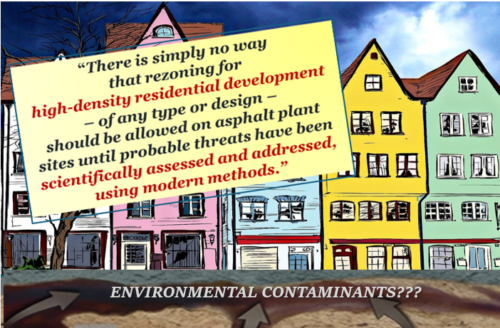
Just to be totally clear: the issue of persistent toxic pollution at abandoned industrial sites is not a site design problem. There is simply no way that rezoning for high-density residential development – of any type or design – should be allowed on asphalt plant sites until probable threats have been scientifically assessed and addressed, using modern methods.
Although there are many other reasons to doubt that this tract is suitable for the rezoning requested, at a bare minimum that should be delayed until this abandoned industrial site can be shown to be safe for residents, neighbors and greenway users, and encumbered with development conditions that prevent offsite movement of toxicants into sensitive surface waters.
If you appreciate the kind of reporting we bring to you
|
Please donate $10 or $20, Thanks for supporting |
 |