
A Raleigh resident for 34 years and a proud homeowner in the historic Glenwood-Brooklyn neighborhood for 24, Roy Attride has been a dedicated neighborhood leader for many years. With a 22-year career in engineering including more than 7 years as a business leader before transitioning into the nonprofit sector in 2021, Roy Attride brings a balanced, solutions-driven perspective to community advocacy.
Passionate about fostering a successful, vibrant, and growing Raleigh, Roy advocates for thoughtful development that engages neighborhoods, supports smart transit and housing solutions, and ensures growth benefits all of Raleigh—not just a select few. Through Livable Raleigh, Roy shares insights, ideas, and advocacy for a Raleigh that thrives through collaboration, inclusivity, and sustainable progress.
We are reprinting this article from Raleigh Neighbors United (RNU). Z-12-25 is the proposed 360 foot tower on West Street.
Why Z-12-25 doesn’t qualify as Transit Land Use category?
What heights are appropriate?
Roy Attride (Raleigh Neighbors United)
Table LU-2, Recommended Height Designations (Stories) from 3.1 Future Land Uses Heights in Mixed Land Use Categories, is the table and policy framework that links Land Use designations (Central Business District, Transit, Core, Edge, General, Neighborhood Center, etc.) to appropriate height ranges and transitions.
From Raleigh Staff: “Table LU-2 in the 2030 Comprehensive Plan, which is what staff relies on for building height guidance“
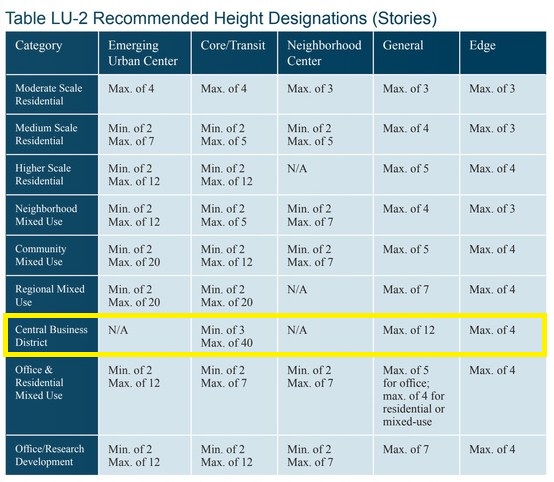
One of the categories that allows the broadest range of heights is the Transit Land Use category (seen in Table LU-2 in the Core/Transit column) which when paired with a Central Business District location suggests a range of 3–40 stories. This is not an entitlement, but ranges are intended to support compatibility, and balanced growth with transitions.
Table LU-2 itself qualifies the height recommendation “Appropriate building heights will vary based on context, and the appropriate height provided through future zoning actions should be determined based on site-specific characteristics and with reference to the relevant Comprehensive Plan Policies.”
In other words, LU-2 is a starting framework. Actual height must reflect context, transitions, and consistency with other policies.
Does the site qualify as TRANSIT?
NO!
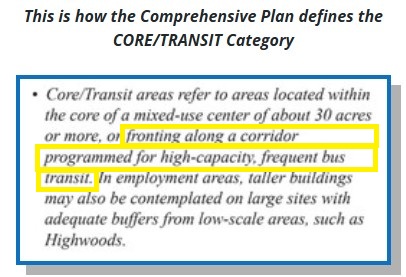
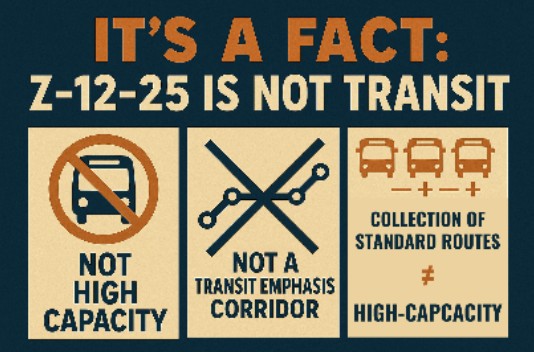
In order for the site to be Transit, it must meet the definition: “fronting along a corridor programmed for high-capacity, frequent bus transit.”
- Fronting along a corridor and
- High-Capacity and
- Frequent
(Comp Plan – Heights in Mixed Land Use Categories: Core / Transit Requirements)
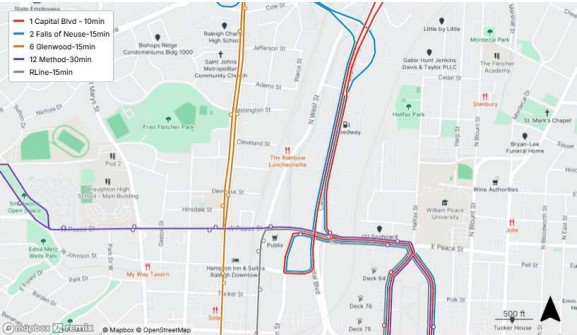
Planning Staff assert this standard is met, citing several routes (R-Line, Route 1–Capital Blvd, Route 2–Falls of Neuse, Route 6–Glenwood, Route 12–Method).
However, they neglected to include high-capacity in their definition and analysis.
Also, we will demonstrate how this area falls short of Transit. We will then dive deeper into the policy guidance leading to moderate height in this location.
High-capacity transit does not simply mean “lots of buses” or “larger buses.” In urban planning, a high-capacity bus corridor is one intentionally designed to move significantly more passengers per hour than conventional bus service, with reliability and travel times that can compete with private cars.
This requires targeted investments such as:
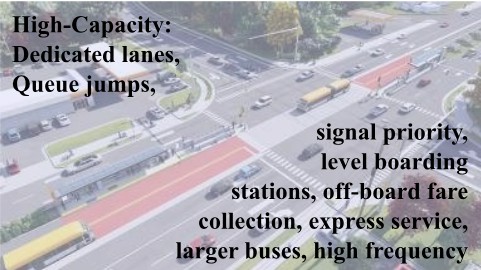
dedicated lanes, queue jumps, transit signal priority, level boarding stations, off-board fare collection, limited-stop or express service, and larger vehicles operating at high frequency. These are the hallmarks of Bus Rapid Transit. None of the cited or planned routes along Peace or West Streets incorporate more than two of these features, and therefore they cannot reasonably be defined as high-capacity.
The definition of Transit requires a site to front a “corridor programmed for high-capacity, frequent bus transit.” That means the corridor itself must be designated for BRT or comparable upgrades. Peace Street does not meet this test: it has no dedicated lanes, queue jumps, level boarding stations, or other BRT infrastructure. Additionally, the Urban Form Map (Downtown Inset) confirms that Peace Street is not a Transit Emphasis Corridor, those corridors are explicitly described as “programmed for a much higher level of bus service, including frequent buses, improved stop amenities, a more complete pedestrian network, and potentially traffic signal priority.” Since Peace Street is not programmed for high-capacity, frequent transit, or designated as a Transit Emphasis Corridor, the site cannot be considered a Transit Land Use category.
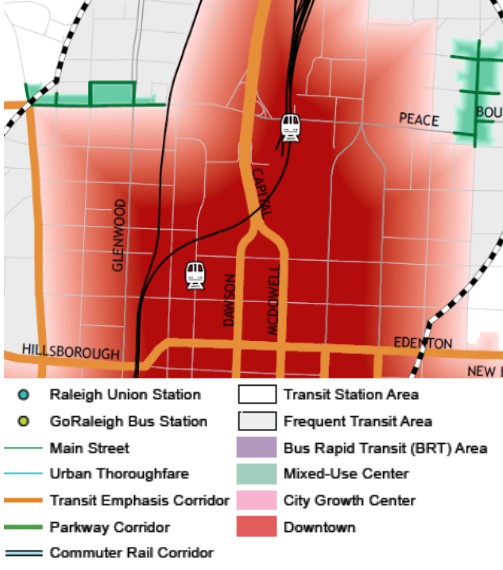
Frontage matters. By definition, a site must have its primary facade, access, or orientation along the transit corridor. Note the frontage has not yet been set for this site but in this case, more than three-quarters of the site’s frontage, 776 feet (76%), is along West Street, with only 238 feet along Peace Street. That means Peace is not the dominant frontage. Again, none of the routes individually or together meet the definition of high-capacity and it is debatable whether the building even “fronts” Peace Street under the definition.
Despite this evidence, some have argued that the area qualifies as “high-capacity” when all the nearby routes are considered together.
A collection of standard mixed-traffic routes does not add up to high-capacity transit.
High-capacity requires BRT-style features, dedicated lanes, queue jumps, level boarding stations, off-board fare collection, and limited-stop or express service, that move significantly more passengers per hour with reliability comparable to private cars. Simply layering several 15- or 30-minute bus routes around a site does not create the capacity or reliability of a programmed high-capacity corridor. If that logic were applied, nearly any cluster of frequent routes across the city could be labeled “Transit,” undermining the very purpose of the Comprehensive Plan distinction.
Under the definition of “frequent,” service must operate every 15 minutes or less. The R-Line does meet this standard, and two of the other cited routes do as well. This might be able to be described as a frequent transit area but frequency even with increased bus size does not qualify the corridor as high-capacity.
There is no doubt that the area is served well by transit. However, it fails to meet the Transit Land Use category definition allowing the largest height ranges.
For a site to be designated as Transit in Table LU-2, it must meet all three criteria ¹fronting along a corridor* programmed for ²high-capacity, ³frequent bus transit. It meets only the frequent requirement and fails the other two tests. It cannot be designated as Transit.
*Please take special notice that the 1st requirement says fronting along a corridor. It does NOT say within 1/4 or 1/2 mile of a corridor or a station area. Only the R-Line and Method actually operate at the Peace St / West St intersection. Only the R-Line is frequent. Neither is high-capacity.
While density is appropriate, moderate height of 144′ and 12 stories is the clear guidance from plans.
Per Plans Height depends on Context and requires Transitions
Even if all of the evidence above were set aside, 3–40 stories is not justified.
Both the 2030 Comprehensive Plan (2030CP) and the Equitable Transit-Oriented Development (ETOD) Guidebook require that height be contextual, with transitions to avoid “jarring juxtapositions of scale and proximity that detract from the character of the historic resource’s setting.” Taken together, the city’s adopted policies make clear that even where maximum heights are considered, they are contingent on context and transitions. The ranges shown in LU-2 and ETOD are not entitlements; they are planning tools intended to ensure compatibility, balanced growth, and appropriate transitions, not unchecked escalation.
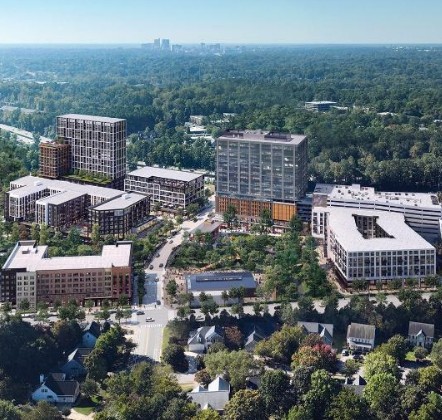
As Table LU-2 states, “Appropriate building heights will vary based on context, and the appropriate height … determined based on site-specific characteristics and with reference to the relevant Comprehensive Plan Policies.” and ETOD reinforces: “The density and building height … should respect the existing neighborhood contexts.” (pp. 44–45).
On transitions, Staff acknowledge that LU-2 establishes a clear progression of height: Edge → General → Core.
Because this site sits just outside the Edge of the Central Business District, General is the appropriate designation.
Jumping directly from Edge to Core within only 40 to 90 feet violates both the letter and the intent of the policy. Additional protections reinforce this point:
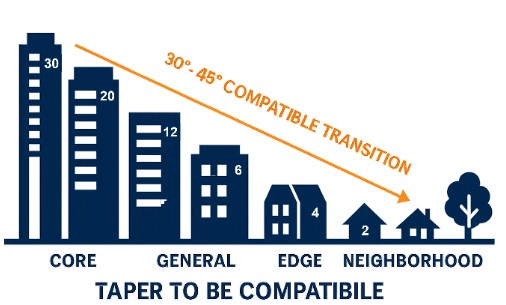
the HGBN Transition Area requires that heights “taper to be compatible,” and no fewer than 13 Comprehensive Plan policies (including 8 Major ones such as DT 1.12 and DT 1.14), Table UD-1, three core definitions, and multiple text sections all emphasize contextual transitions. Urban planning best practices, used in many cities, echo this guidance, typically recommending a 30°–45° slope for step-downs. Applied here, that slope supports a height of roughly 12 stories (150 ft), a level that accommodates growth while remaining consistent with adopted policy. In short, density on this site is appropriate, but only at a moderate height that sustains Raleigh’s long-term vision for livability and balance.
Conclusion
The site does not qualify as Transit under the Comprehensive Plan, and even if it did, the height range in LU-2 is not an entitlement but a maximum, subject to context and transitions. Peace and West Streets lack the BRT style investments required for a Transit designation, and the overwhelming frontage on West St further weakens that claim.
The Comprehensive Plan’s guidance is clear: growth here should be significant, but balanced, with moderate height that respects the surrounding neighborhood and historic context. The appropriate outcome is 12 stories (150 ft), a scale that delivers density while upholding Raleigh’s long-term vision for livability, compatibility, and thoughtful urban transitions.
Roy Attride, Raleigh Neighbors United
For more information and analysis go to RaleighNeighborsUnited.com
The neighbors support the current zoning which allows for 12 stories.
12 stories IS DENSITY
12 stories provides needed housing
NOTE from Livable Raleigh – Mayor Cowell says she is keeping track of her email on the issue of the proposed 30-story tower at West St. If you are opposed to it and want to see Raleigh honor the Comprehensive Plan as Mayor Cowell said we should, then please email the Mayor and ALL the City Council to express your concerns. This email address will send your message to all council members: citycouncilmembers@raleighnc.gov or you can find complete contact information for each councilor and their social media accounts here: City Council Contacts
Stop Z-12-25 West St Tower – Sign the Petition
Z-12-25 Stomps on Raleigh’s Comp Plan
Why Z-12-25 Fails Raleigh’s Vision
A Flawed Foundation for Deliberations
4 Easy Steps to Analyze Z-12-25
Putting Your Thumb on the Scale is Wrong!
Z-12-25 Fails Raleigh’s Three-Layer ReZoning Test
Growth with Consequences Risk to Neighborhoods
A Threat to Every Raleigh Neighborhood
Height Without Transition Risks Raleigh’s Future
The Impact of Cherry-Picking Policy – Part One
The Impact of Cherry-Picking Policy – Part Two
The Impact of Cherry-Picking Policy – Part Three
The Impact of Cherry-Picking Policy – Part Four
Is West St in the Core of Downtown?
Do City Plans have a Use By Date?
West St Tower Violates Raleigh Downtown Plan
West St Tower Violates Equitable Transit Development
West St Tower Violates the Capital Blvd Corridor Study
West St Tower Proposal Violates the Comprehensive Plan
West St Tower Neighborhood Meeting – All Stand!
Want to know more about these signs?
If you appreciate the kind of reporting we bring to you
|
Please donate $10 or $20, Thanks for supporting |
 |