
A Raleigh resident for 34 years and a proud homeowner in the historic Glenwood-Brooklyn neighborhood for 24, Roy Attride has been a dedicated neighborhood leader for many years. With a 22-year career in engineering including more than 7 years as a business leader before transitioning into the nonprofit sector in 2021, Roy Attride brings a balanced, solutions-driven perspective to community advocacy.
Passionate about fostering a successful, vibrant, and growing Raleigh, Roy advocates for thoughtful development that engages neighborhoods, supports smart transit and housing solutions, and ensures growth benefits all of Raleigh—not just a select few. Through Livable Raleigh, Roy shares insights, ideas, and advocacy for a Raleigh that thrives through collaboration, inclusivity, and sustainable progress.
We are reprinting this article from Raleigh Neighbors United (RNU). Z-12-25 is the proposed 360 foot tower on West Street.
Summary of Opposition: Say No to Z-12-25
Z-12-25 Doesn’t Fit Raleigh’s Plans or Vision
Roy Attride (Raleigh Neighbors United)
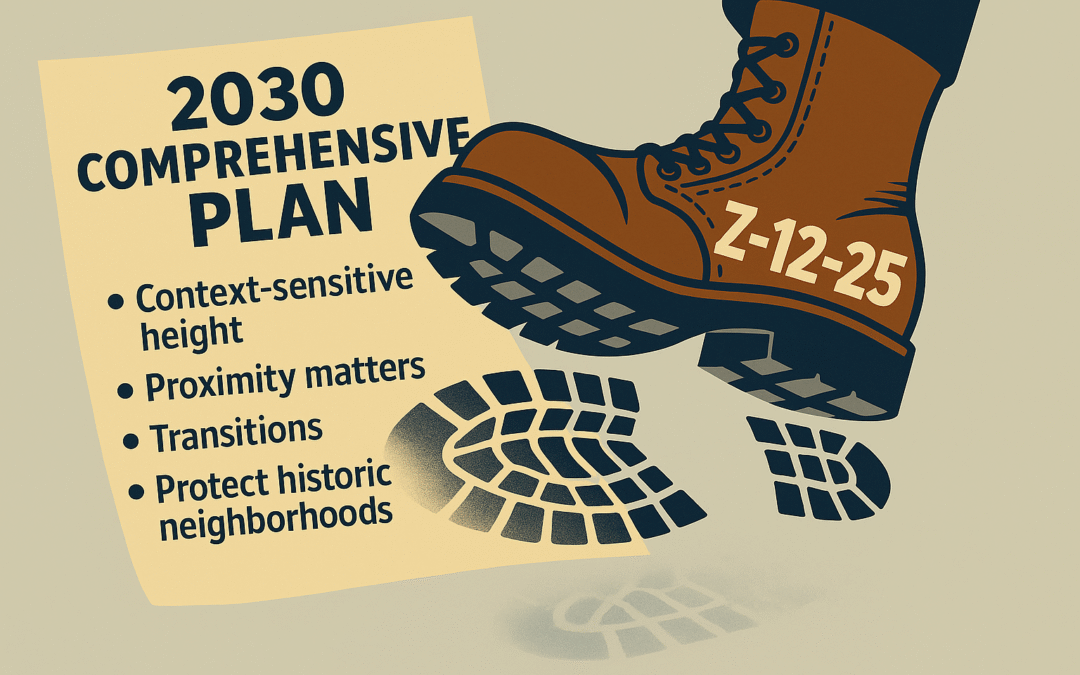
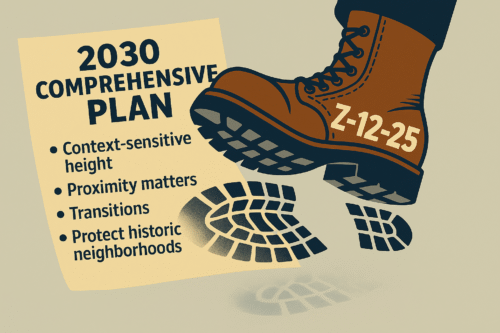
Raleigh’s growth must be smart, balanced, and respectful of the neighborhoods that make our city livable. The 2030 Comprehensive Plan and related plan provide a clear roadmap: height should be context-sensitive, protect historic neighborhoods, and create a cohesive urban fabric. Allowing 240-foot and 360-foot towers directly beside a historic district is the opposite of that vision.
The opposition to Z-12-25 isn’t emotional or speculative—it’s grounded in fact-based analysis of Raleigh’s adopted plans, policies, and urban planning best practices. When interpretation is needed, the points against this rezoning rest on the broader text, intent, and consistency of the 2030 Comprehensive Plan (2030CP). These policies aren’t optional—they define where and how Raleigh should grow.
Raleigh residents and organizations stand in strong opposition to this rezoning because it violates the city’s plans and policies and threatens lasting damage to neighborhoods and the city.
Below are the main opposition points with links to the full body of content: plain-spoken, quick-read articles; executive summaries of core arguments; and detailed, in-depth analyses tied directly back to adopted policies. All of it is linked, starting with the most relevant, so you can easily follow each thread down to the policies themselves.
The Core Reasons for Opposition
1. Proximity to a Historic Neighborhood
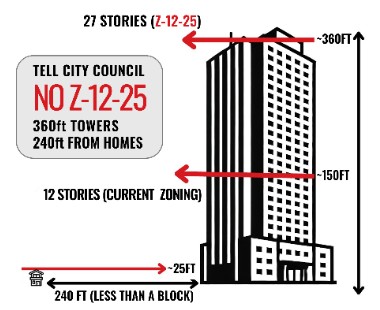
The site is directly adjacent to the Historic Glenwood-Brooklyn Neighborhood (HGBN). Towers of 240’ and 360’ (25–27 stories) would overwhelm the character and livability of this community. The Comprehensive Plan recognizes adjacency and proximity as critical factors in setting appropriate height.
(Detailed Analysis: Adjacent Analysis Z-12-25)
Read more: Summary: Executive Summary of Opposition To Z-12-25 Detailed: Analysis: Table LU-2 & Transit Station Areas, Articles: The Staff Report on Z-12-25; Proximity, Transitions, Neighborhoods and Precedent, Summaries: Executive Summary Analysis of Z-12-25 Staff Report, Opposition Overview: Policy & Logic
2. Height & Density Guidance from Policy
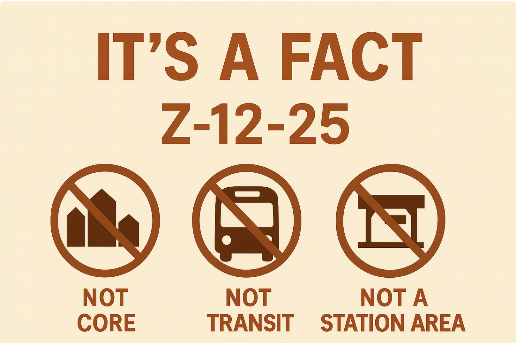
Policy LU-2 and related station area guidance make clear this site is not Core, not Transit, and not a Station Area. Urban form overlays cannot be stitched together to fabricate a mixed-use center, and Peace Street does not qualify as High-Capacity transit. Station Areas are only established through detailed design, which has not started. So, no such designation exists for this site. By policy, the site falls under the General category with a maximum of 12 stories. No other plan or policy justifies 240′- 360′ (25–27 story) towers here.
3. Context and Transitions
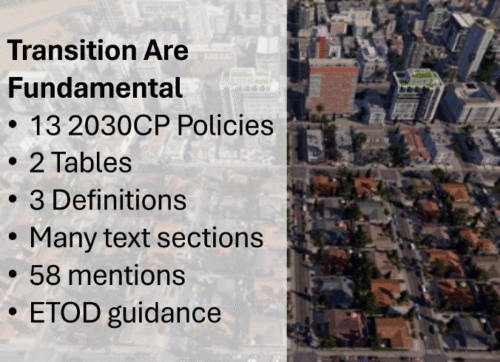
Raleigh’s own plans are clear: maximum heights are always contingent on context and transitions. LU-2 calls for “appropriate building heights based on context.” The ETOD guide states density and height should “respect existing neighborhood contexts” and “transition downward” to connect with lower-density districts. Transitions are not optional—they are the mechanism the Comprehensive Plan uses to ensure growth is compatible, livable, and sustainable. Effective transitions require a gradual step-down in scale, not an abrupt drop from towers to two-story homes.
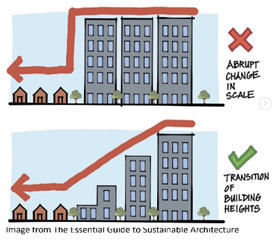
Jumping from Edge to Core in just 90 feet defies both the letter and the spirit of these policies. Planning best practice also uses a 30°–45° slope for transitions—on this site, that equates to about 12 stories.
Read more: Summary: Executive Summary of Opposition To Z-12-25 Articles: Proximity, Transitions, Neighborhoods and Precedent, Height Without Transition Risks Raleigh’s Future, Summaries: Opposition Overview: Policy & Logic, Detailed: 2030CP analysis report)
4. Protecting Historic Resources
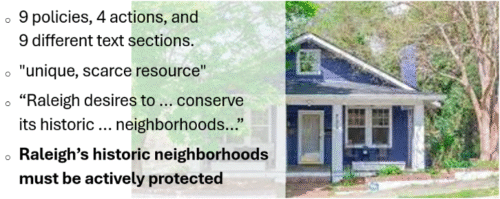
The 2030CP calls historic neighborhoods “unique, scarce resources” and “one of Raleigh’s major assets.” Nine policies, four actions, and a dedicated section on preservation reinforce this commitment.
Reducing height, limiting shadow and glare, and requiring transitions are not optional—they are necessary to safeguard neighborhood character and uphold Raleigh’s long-term vision.
Read more: Summary: Executive Summary of Opposition To Z-12-25 Articles: Proximity, Transitions, Neighborhoods and Precedent, Height Without Transition Risks Raleigh’s Future, Summaries: Opposition Overview: Policy & Logic, Detailed: 2030CP analysis report)
5. Comprehensive Plan Consistency
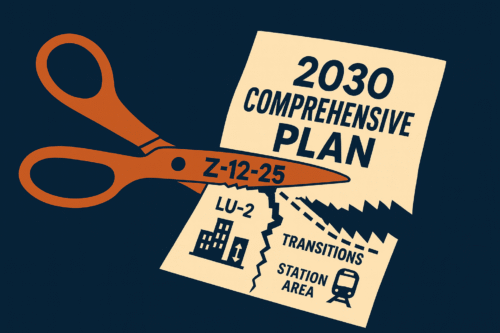
Z-12-25 cuts across 31 Comprehensive Plan policies, including nine Major policies, three core definitions, and two critical tables. Its conflicts are also reinforced by the ETOD Guidebook, the Capital Boulevard Corridor Study, and the Downtown Small Area Plan. Claims of consistency are either immaterial, refuted, or capped at 12 stories. Raleigh’s success depends on following the plan and its intent.
Read more: Summary: Executive Summary of Opposition To Z-12-25, Details: 2030CP analysis report, Article: The Staff Report on Z-12-25 Summary: Executive Summary of the Staff Report Analysis, Detailed: Full Analysis of the Staff Report Analysis
6. Dangerous Precedent
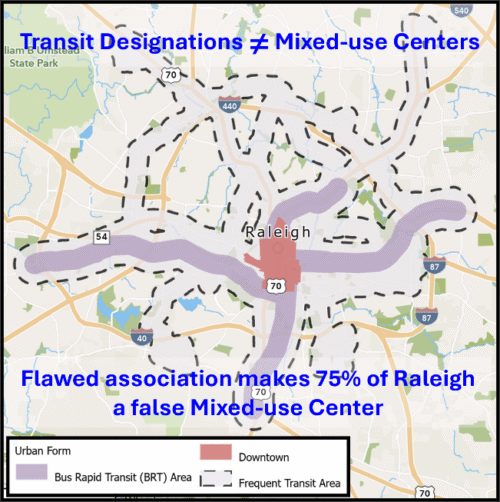
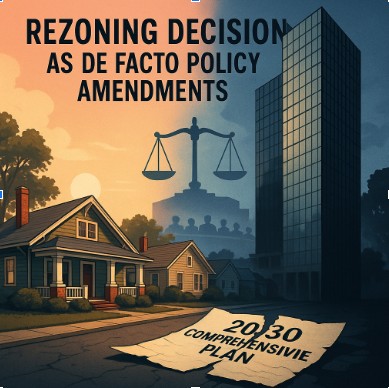
Approval would rewrite policy to allow towers of this scale beside any neighborhood, stripping away protections citywide. Worse, treating combined transit overlays as a “mixed-use center” could falsely classify over 75% of Raleigh as eligible for maximum height. This would undermine the Comprehensive Plan and remove Raleigh’s ability to manage growth responsibly.
The Shaw University rezoning (Z-59-22) is not a precedent. That decision was a narrowly tailored exception to support an HBCU’s survival, recognized by Council as a deviation—not a template.
Read more: Summary: Executive Summary of Opposition To Z-12-25, Articles: Z-15-25 Precedent: A Threat to Every Raleigh Neighborhood, The Staff Report on Z-12-25; Z-12-25 and the Risk to Raleigh’s Neighborhoods Summary: Executive Summary of the Staff Report Analysis, Detailed: Full Analysis of the Staff Report
7. Community Opposition
Opposition is broad and deep:
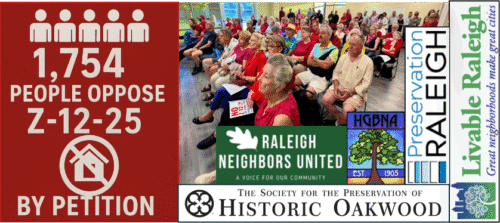
- 1,754+ petition signatures
- 250+ neighbors at public meetings
- Residents across Mordecai, 5 Points, Boylan Heights, Forest Park, North Hills, and beyond.
- Organizations including Preservation Raleigh, Raleigh Neighbors United, Livable Raleigh, the Society for the Preservation of Historic Oakwood, Historic Glenwood- Brooklyn Neighborhood Association
8. A Flawed Staff Report
The staff report misclassifies the site, omits key policy conflicts, and declares no detriments identified. This creates an illusion of consistency where none exists, inflating benefits and minimizing impacts. Council deserves a full, accurate picture—not a one-sided report.
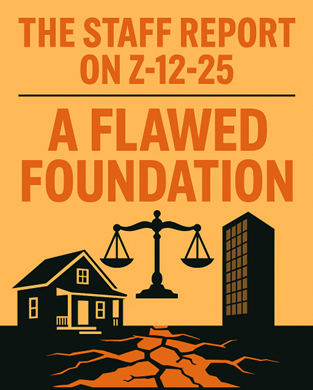
Read more: Summary: Executive Summary of Opposition To Z-12-25, Article: The Staff Report on Z-12-25 Summary: Executive Summary of the Staff Report Analysis, Detailed: Full Analysis of the Staff Report Analysis

9. Developer Misrepresentation of Policy
The developer leans on selective readings: misusing the FLUM (LU-3), substituting the Urban Form Map for land use categories, referencing an obsolete Transit Station Map (LU-5), and twisting transition guidance contradicted by the 2030CP. Policy must be read as a whole. Taken together, the message is clear: this site supports 12 stories, with context-sensitive transitions and protection for the adjacent historic neighborhood.
Read more: Summary: Executive Summary of Opposition To Z-12-25 Article: Z-12-25 and The Impacts of Cherry-Picking Policy
The Bottom Line
Raleigh has the tools and the policies to manage growth responsibly. Z-12-25 ignores them. Approving this rezoning would not only damage a historic neighborhood but also set a precedent that threatens every neighborhood in Raleigh. The Comprehensive Plan shows us the path forward: moderate, context-sensitive growth that strengthens, not undermines, our city’s future.
Roy Attride, Raleigh Neighbors United
For more information and analysis go to RaleighNeighborsUnited.com
The neighbors support the current zoning which allows for 12 stories.
12 stories IS DENSITY
12 stories provides needed housing
NOTE from Livable Raleigh – Mayor Cowell says she is keeping track of her email on the issue of the proposed 30-story tower at West St. If you are opposed to it and want to see Raleigh honor the Comprehensive Plan as Mayor Cowell said we should, then please email the Mayor and ALL the City Council to express your concerns. This email address will send your message to all council members: citycouncilmembers@raleighnc.gov or you can find complete contact information for each councilor and their social media accounts here: City Council Contacts
Stop Z-12-25 West St Tower – Sign the Petition
Z-12-25 Does Not Meet Transit Land Use Criteria
Why Z-12-25 Fails Raleigh’s Vision
A Flawed Foundation for Deliberations
4 Easy Steps to Analyze Z-12-25
Putting Your Thumb on the Scale is Wrong!
Z-12-25 Fails Raleigh’s Three-Layer ReZoning Test
Growth with Consequences Risk to Neighborhoods
A Threat to Every Raleigh Neighborhood
Height Without Transition Risks Raleigh’s Future
The Impact of Cherry-Picking Policy – Part One
The Impact of Cherry-Picking Policy – Part Two
The Impact of Cherry-Picking Policy – Part Three
The Impact of Cherry-Picking Policy – Part Four
Is West St in the Core of Downtown?
Do City Plans have a Use By Date?
West St Tower Violates Raleigh Downtown Plan
West St Tower Violates Equitable Transit Development
West St Tower Violates the Capital Blvd Corridor Study
West St Tower Proposal Violates the Comprehensive Plan
West St Tower Neighborhood Meeting – All Stand!
Want to know more about these signs?
If you appreciate the kind of reporting we bring to you
|
Please donate $10 or $20, Thanks for supporting |
 |