Included in your consent agenda today are approvals for several requests to transfer funds to several road projects located throughout the City. What you may not know is that most of these projects were outlined in the 2017 Transportation bond, which also included the Six Forks Road Improvement project.
While I don’t know the updated costs of those road projects, I do know that they added funds from the cancellation of the Six Forks Road project, again showing that the City is not completing infrastructure projects in a timely manner while costs continue to escalate.
One has to wonder if these projects would have moved forward if the Six Forks Road project had been supported.
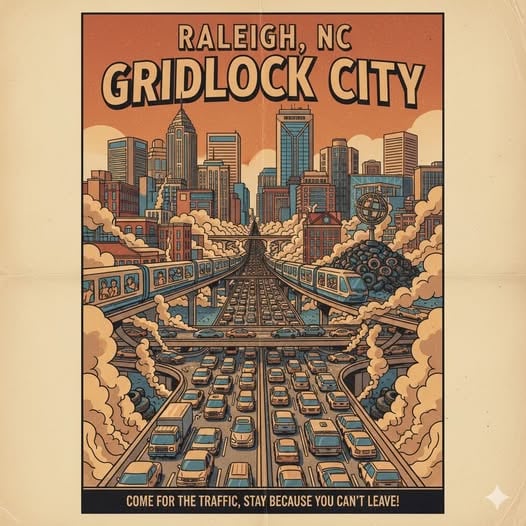
This brings me to my main point. The City is falling behind in infrastructure support for the current policy of density, density everywhere. You don’t see this impact so much downtown because the area has a network of streets that are laid out in a grid pattern and cannot be improved.
However, it is very apparent in areas that surround downtown that are considered sprawl. These streets and corridors are critical to the growth of the City, yet they are never the subject of any development, other than traffic studies that show the reality that suburban roadways are already overloaded with traffic and the added density will only further stress this infrastructure without further City planning and execution.
The City does have a plan to support that growth. It is called a Comprehensive Plan.
Does the City follow that plan when adding density? Most times, the answer is no because the Comprehensive Plan is not an ordinance. It is just a guide.
To make matters worse, Missing Middle has given applicants an opportunity to add that density without public input or inclusion.
When density is added due to proximity to frequent transit or BRT corridors, they are given administrative approval without that question of roadway capacity, safety of egress, and stormwater impact.
While these added developments support density, density everywhere, they are destroying the integrity of communities that were designed with street grids that could accommodate their original construction with full services but not when adding unplanned density on top of them.
One may counter with the City’s current plan to add BRT mass transit. While the New Bern corridor is elaborate and the roadway is being designed to accommodate that project, this is not the case in the other proposed corridors. For those corridors, the question will be whether a bus can move any better or faster than the cars it is intended to replace on roadways that are already established and get more congestion daily as more density is added on those same pathways.
There is hope at the end of the tunnel. You have started to look at whether the City can afford to continue to annex new areas of the City. I suggest that you ask that same question when a rezoning comes in front of you for approval.
Larry Helfant
A 45-year Suburban Survivor
* Please add this to public comment for Council meeting on October 21, 2025
If you appreciate the kind of reporting we bring to you
|
Please donate $10 or $20, Thanks for supporting |
 |