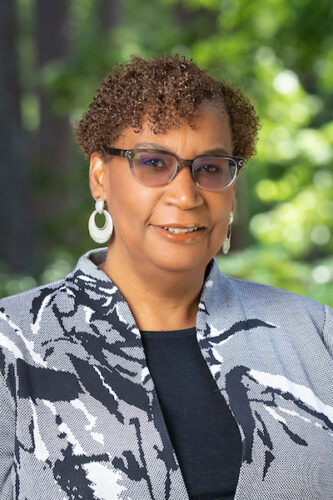
Mary Thompson is a dedicated advocate for diversity, equity, and inclusion, with a strong focus on community engagement in support of the U.S. Truth, Racial Healing, and Transformation movement. She was recently elected to the NAACP Raleigh-Apex Branch Board of Directors and actively serves on the Wake County Continuum of Care Funding Review Committee, the Fair Housing Advisory Committee, and the League of Women Voters. Mary also supports Raleigh Organizing Against Racism (ROAR) and serves on the Dix Park Legacy Committee. As a former Chair of the Raleigh Human Relations Commission, Mary remains deeply committed to advancing the Resolution to Support Reparative Justice for African Americans and to advocating for the creation of an African American Affairs Board in the City of Raleigh. In addition, Mary serves as an ambassador and educator for the Alzheimer’s Association, where she advocates for federal research funding and works to raise awareness and provide support for individuals and families across North Carolina affected by the disease
Mary spoke to City Council on October 14, 2025:
Hello Mayor and City Council,
I served as a Human Relations Commissioner for six years and had the opportunity to serve in leadership roles. During my time on the Commission, every project or activity we undertook was part of a work plan approved by the City Council. Throughout my tenure, the HRC advocated for the Director of Equity and Inclusion position. The HRC conducted research, held community feedback sessions, and made recommendations for the creation of several important boards — including the Police Advisory Board, Hispanic Affairs Board, Immigrant Affairs Board.
The HRC introduced the National Day of Racial Healing to the City of Raleigh. The HRC had an event with National Alliance on Mental Illness (NAMI) and held a few food distribution events during COVID and over the years has participated and supported numerous community events.
During my time on the HRC, resolutions were initiated by various Raleigh community members. In 2021, members from the Quaker community brought forward the Reparative Justice Resolution and in 2020 members of the African American community brought forward the African American Advisory Board directly to the City Council members.
The current proposal to eliminate boards — or to merge multiple community-focused efforts into a single entity — is deeply disappointing. As a volunteer commission, the HRC is not structured to provide adequate attention and voice to the wide range of community issues.
I and other residents of Raleigh look forward to seeing how the new HRC structure will advocate for the important issues for a very diverse Raleigh community. I know we all want to make sure that all residents have the ability to have their voices heard more than a 2 or 3 minute public comment.
Thank you for your time and attention.
If you appreciate the kind of reporting we bring to you
|
Please donate $10 or $20, Thanks for supporting |
 |