Mark Teague, Executive Director of JETCV, submitted the following for publication:
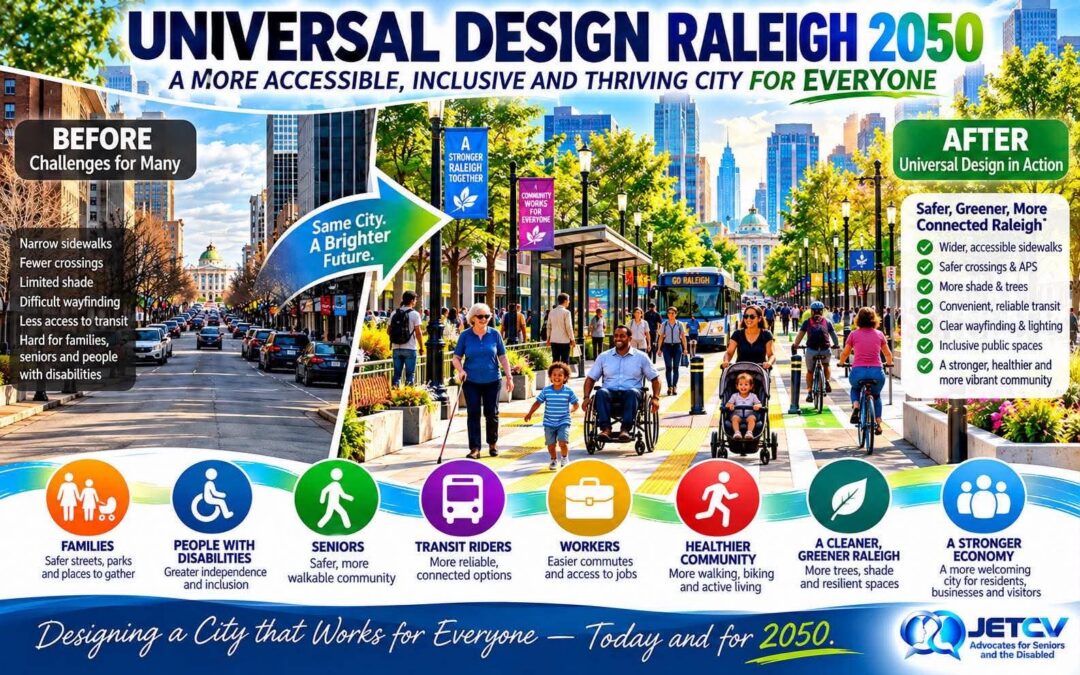
What if Raleigh had an opportunity to become a national leader in accessibility, safety, and inclusion by adopting Universal Design as a citywide policy?[1]
Dr. Rickey Scott, Chair of the Raleigh Commission for Persons with Disabilities, has presented a proposal[2] to City Council encouraging Raleigh to formally embrace the concept of Universal Design. This would be an opportunity to establish a coordinated approach across City departments, with the ADA Coordinator actively involved in planning, policy development, infrastructure improvements, and decisions affecting our community.
The goal is not simply to meet the minimum requirements of the Americans with Disabilities Act. It is to create a city where accessibility, safety, and inclusion are considered from the very beginning of every project rather than after problems have already occurred.
The disability community has helped create solutions that everyone benefits from.
Think about the audible warning sounds on electric vehicles. When electric vehicles first entered the market, their quiet operation created serious safety concerns for people who are blind or visually impaired. Advocacy from the National Federation of the Blind and other organizations helped bring about federal requirements for pedestrian warning sounds.
Consider automatic doors, curb ramps, accessible pedestrian crossings, improved lighting, and other features that have become part of everyday life. Many of these improvements came through years of advocacy by people with disabilities, yet they benefit seniors, parents pushing strollers, children, visitors, and the entire community.
This is the power of Universal Design.
But here is the question I continue asking: How often does the City of Raleigh truly listen to the voices of its disability community before making decisions?
Raleigh recognized the importance of disability representation decades ago, with advocacy structures dating back to the 1970s. Approximately 50 years later, we are still asking whether the community is being included early enough in decisions that directly affect our lives.
During my approximately three and a half years of advocacy, I have become increasingly concerned about how infrequently the City’s ADA Coordinator appears to be included in important discussions across departments.
One example is the closure of the Wilmington Street pedestrian tunnel connecting the GoRaleigh Station area with destinations around downtown.
This decision created serious questions about safe and accessible pedestrian travel, particularly for people with mobility disabilities and visual impairments trying to reach Moore Square, Marbles Kids Museum, Fayetteville Street, and surrounding destinations.
What troubled me was not simply the closure itself, but the process.
The announcement appeared on television even though the Raleigh Transit Authority had met just six days earlier without being informed of the impending change. Board members subsequently raised questions about the timing, communication, and implications of the decision.
Why were those conversations not occurring earlier? Was the ADA Coordinator involved in the initial planning? Were people with disabilities consulted before the decision was finalized? Were accessible alternatives evaluated and clearly communicated?
These are reasonable questions that deserve answers.
Had accessibility and Universal Design been incorporated into the earliest discussions, I believe many concerns could have been identified and addressed before the public announcement.
This is exactly why Raleigh needs a citywide Universal Design policy.
Imagine an approach in which Transportation, Planning, Engineering, Parks, Housing, Public Utilities, and other departments work together under a coordinated accessibility framework, with the ADA Coordinator involved in decisions that affect people with disabilities.
Instead of reacting to problems, Raleigh could prevent many of them.
I have included the documentation and proposals we shared with incumbent City Council members and candidates running for office. These materials outline our ideas for implementation, coordination, investment, and community participation. See References below
As Raleigh considers future investments in affordable housing, transportation, and infrastructure, Universal Design deserves to be part of that conversation. Our initial proposal calls for approximately $1.4M to begin establishing this coordinated approach. Compared with the scale of major proposed bond investments, that would represent a relatively small commitment with the potential for significant long-term benefits.
Many American cities have already implemented individual Universal Design principles. Raleigh has an opportunity to go further by creating a formal, coordinated policy that reaches across City government.
This is not about creating another layer of bureaucracy. It is about improving communication, accountability, and coordination while making sure the voices of people with disabilities are heard before decisions are made.
One of my favorite phrases when speaking with City Council is simply:
“Help me understand.”
-
- Help me understand why accessibility is too often addressed after decisions have already been made.
- Help me understand why people with disabilities continue to encounter barriers that could have been prevented.
- And help me understand why we would not embrace an approach that could make Raleigh safer, more welcoming, and more accessible for everyone.
We are all part of a village. When residents, advocates, City staff, elected officials, and community organizations work together, we can create meaningful solutions.
Mark S. Teague
Founder and Executive Director
JETCV — Joining Experiences Together to Create a Voice
Advocates for Seniors and Persons with Disabilities
Nothing About Us Without Us
If you appreciate the kind of reporting we bring to you
|
Please donate $10 or $20, Thanks for supporting |
 |