
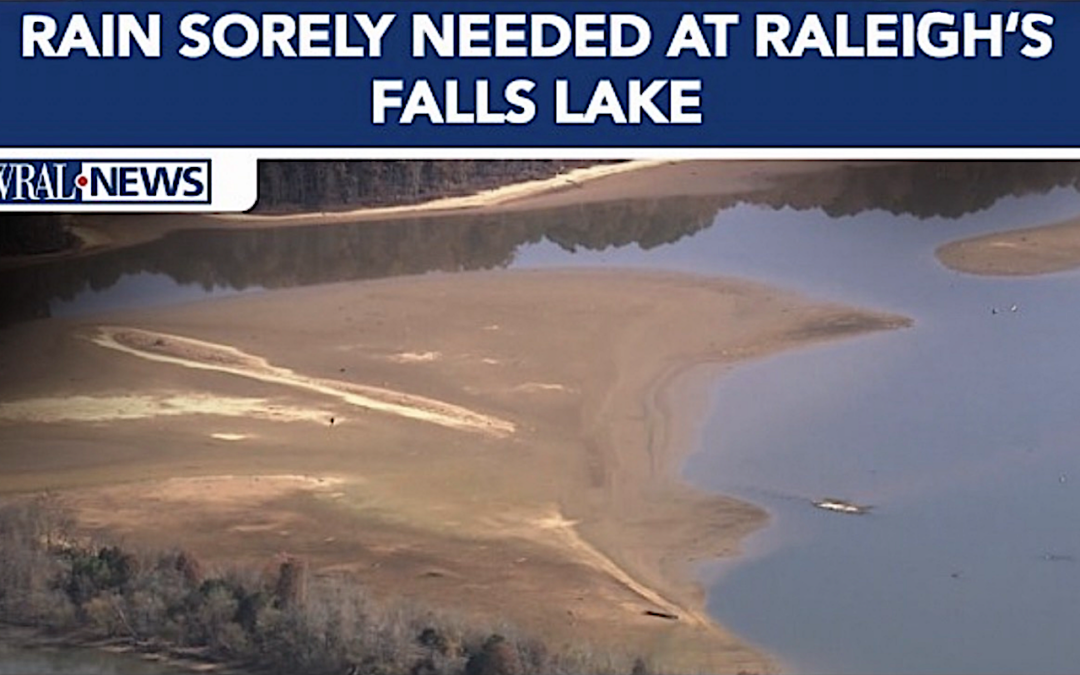
For full details, see the independent analysis below by Raleigh resident and long-time observer of Raleigh and Wake County’s water management efforts, Jeri Gray.
RALEIGH’S WATER PLAN IS LATE! Raleigh Water managers are still searching for water supply.
All public water supply providers in North Carolina are required to file with the N C Division of Water Resources an annual report on the past year’s water use and plans for future water supply. The last plan Raleigh’s water utility filed was for 2024. Its 2025 plan was due in April and has not yet appeared.
At the morning session of the September 12 City Council meeting, Raleigh Water’s Director Whit Wheeler shared information the utility is compiling for the overdue report. My analysis of what he reported strongly suggests that Raleigh and Wake County does not have and may not be able to acquire adequate water supply to support growth at the current rate.
HOW CLOSE WE ARE TO A WATER DEFICIT? Recall that Falls Lake is the primary source of public water supply for Raleigh and most of Wake County’s smaller eastern towns. Raleigh Water’s 2024 Water Supply Plan shows the available raw supply from Falls as 88.2 million gallons per day (MGD) and from secondary sources (Swift Creek’s Lake Benson and Lake Wheeler) as 11,200 MGD. That is a total raw supply of 99.4 MGD.
Raleigh’s 2024 plan reported total water demand of 56.3 million gallons per day. Subtract total demand in 2024 from total raw supply and it leaves only 43.1 MGD to accommodate increasing demand between 2024 and now. In that time, Raleigh’s population grew to more than a half million and growth also engulfed Wake County, particularly in the “merger” towns that Raleigh Water also serves.
Because the 2025 water report/plan has not been filed, there is no publicly available information concerning water demand growth since 2024. Raleigh Water’s presentation to the City Council did not include demand information, and none of the councilors asked for it. We do know that no additional water supply for Raleigh and Wake County has come online since 2019 when the Corps of Engineers approved a reallocation of water from Falls Lake. The 2024 plan listed a project to provide a small increase in water supply from Raleigh’s secondary reservoirs to be online this year. That project did not go forward.
All this suggests that Raleigh and Wake County could be close to a water supply deficit. However, no pending deficit has become apparent because the drought forced water use restrictions and water use reporting was delayed. If spring precipitation returns to “normal” and Falls Lake fills up, any supply deficit may not become evident until next summer when demand traditionally rises beyond “average day.” The 2024 plan shows maximum day withdrawals from Falls in the summer of 2024 as 68.40 MGD. With total supply still at 99.4 MGD, growth in demand from 2024 to now could push the summer max-day demand beyond supply and necessitate conservation restrictions like we saw this year.
In Wheeler’s presentation, there was some indication that the managers of our water utility have considered this scenario and are planning to begin actual enforcement of year-round conservation and changes to conservation triggers.
The main target for conservation will be outdoor irrigation. According to Director Wheeler, residential uses account for 61 percent of demand, but the utility assumes that per-person domestic use will drop with no effort on their part, because households will continue to replace older water-using appliances with increasingly efficient appliances. This assumption is dangerous. There is no way to quantitively predict a drop in demand that relies on continually improving water efficiency which is heavily influenced by federal government policy.
What are the possible sources of additional water supply? For substantial long-term water supply, Raleigh Water seems to be grasping at straws.
According to Wheeler, an option just studied was an allocation from Kerr Lake, a U.S. Army Corps of Engineers (USCOE) Lake on the Virginia state line in the Roanoke River Basin. This is the second time Raleigh has looked at Kerr Lake as possible supply. The first time was around 2006, and that evaluation showed an estimated cost of $700 million to build a 50-mile (perhaps two-way) pipeline and additional costs for environmental assessments and application for inter-basin transfer authorization from the N.C. Environmental Management Commission. The project was considered infeasible then.
Since 2006, costs of infrastructure have gone up and competition for Kerr Lake water has increased. A major drinking water allocation goes to the Kerr Lake Regional Water System which holds inter-basin transfer authorization and provides water to numerous entities in Virginia and several counties in North Carolina. Other entities (including a power generator) also have agreements with the USCOE for significant amounts of Kerr Lake water. In addition, Franklin County in N C is currently asking for an individual drinking water allocation from Kerr Lake.
The fact that Raleigh Water has considered Kerr Lake a second time indicates desperation as well as the probability that Raleigh and Wake County will have to rely on small but expensive water supply projects to support the area’s water needs.
What kind of projects might those be? A near-term option under serious consideration is a potable reuse project at the Dempsy Benton Water Treatment Plant in Garner This project would serve south Raleigh and Garner. Potable reuse involves blending treated wastewater from the service area with water from Lake Benson and treating that blended water to drinking water standards. If I heard correctly, this option could add 17 MGD to the total supply. It will involve constructing significant new infrastructure. The target date for completion of this project will probably appear in the upcoming 2025 report.
Another supply project under consideration is a new water intake and water treatment plant on the Neuse River below the Falls Lake Dam. According to Director Wheeler, the new intake and plant would be located near Poplar Creek which enters the Neuse River in southeastern Wake County. According to Raleigh Water calculations, this intake and treatment plant could add up to 45 MGD to the system’s water supply at a reasonable cost. Studies required for permitting will be started, with hope to bring the project online by 2040. This option is concerning because Raleigh has already used a Neuse River intake (admittedly in another location) and found it was not very dependable. The Neuse is not a deep river and in the heat of summer the water level drops considerably.
One year when the original Neuse intake was being used, Raleigh had to get emergency water from Butner’s reservoir upstream to meet demand.
For long-term supply the remaining possibility is constructing the Little River Reservoir in eastern Wake County. Land for this project has already been acquired, and an environmental scoping study was almost completed in around 2005-6 before it became evident that the cost for mitigation of wetlands destruction and endangered species protection would be enormous. If I remember correctly, a USCOE study put the mitigation cost alone at $ 400 million, and the reservoir would produce only 12 million gallons a day. It seems this option has been put off again—this time to 2060.
At the September 12 council meeting there were few questions from councilors about the studies and projects reported on. Several questions indicated a lack of knowledge about our water history and situation and perhaps a lack of understanding of what the questioners had just heard. Several councilors had questions and suggestions concerning conservation measures, including one to use the tiered rate system to “squeeze” irrigation users. Others suggested more public education about how much water is needed to maintain lawns and other landscaping. However, no one on council mentioned controlling growth as a solution to Raleigh and Wake County’s water supply dilemma.
Slowing growth should be seriously considered because it is doubtful that conservation measures alone can provide the water needed if growth and water demand continue on their current trajectory.
If you appreciate the kind of reporting we bring to you
|
Please donate $10 or $20, Thanks for supporting |
 |