Bob Mulder, former Chair of Raleigh’s Planning Commission, responds to an article from the N&O in which he was quoted.
We are publishing it here with his permission.
Here are my observations about the Sunday, April 12, 2026 article entitled “The Triangle’s new growth war.”
An N&O editor once told me that headlines are not written by the journalist who wrote the article but by someone else on staff.
I would have written the headline differently. I know that headlines are written to grab attention, but in the hyper-political milieu in which we all find ourselves, I think that perhaps a more descriptive and calmer headline might have been the way to go. Maybe something like “The Triangle’s new growth discord.”
In the current political environment in our country there has been and continues to be lots of shouting and chest beating, so when the descriptive term “vocal critic” is used I think that many folks have a picture in their mind of a rather boisterous person. I would much rather have been characterized as a “thoughtful critic.” I am neither a chest beater nor boisterous. Maybe someday the term “vocal critic” may gain back its respectability.
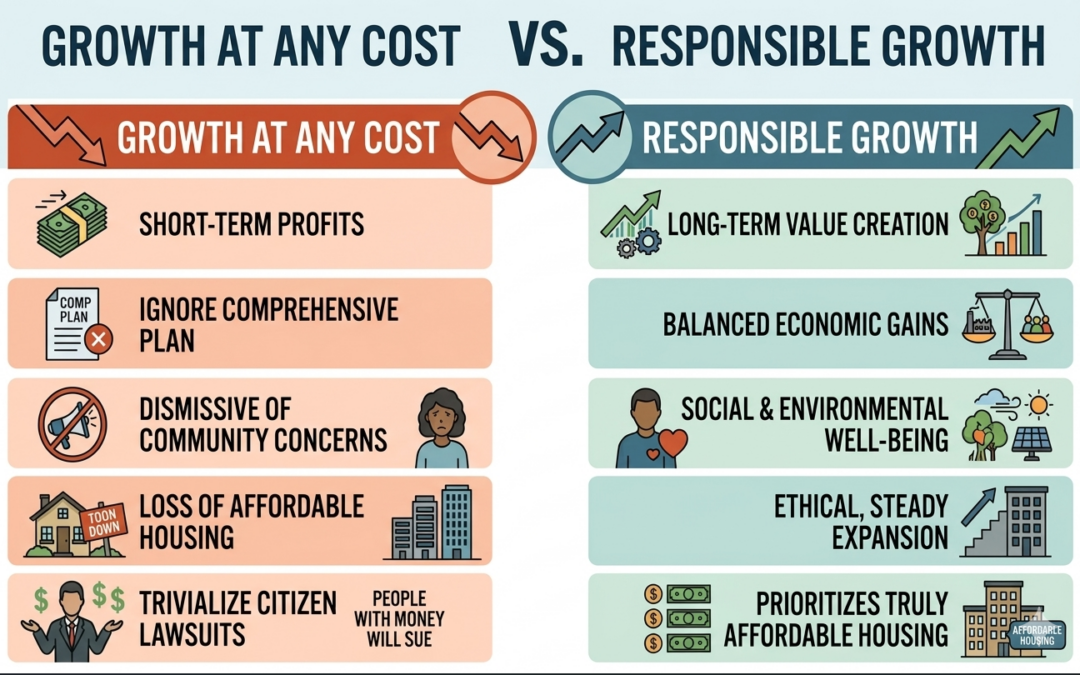
Mayor Cowell’s response to my comment that the current rash of lawsuits are a sign of dysfunction in our planning process was “I don’t believe we’re ignoring the comprehensive plan” and “People with money will sue.” The fact is that the council is ignoring the comprehensive plan when it does not suit them and trivializes the motives of citizen lawsuits.
There is no question that some lawsuits filed in this country are frivolous. However, the Mayor’s comment implies that the lawsuits filed by Raleigh citizens are frivolous. I think that the Raleigh citizens who filed these lawsuits might be justified in feeling insulted. And yes, filing a lawsuit is an expensive strategy, but the fact that only wealthy neighborhoods can pursue legal strategy is not inequitable. I am certain that neighborhoods with fewer financial resources are thankful that some of their wealthier neighbors are also looking out after their interests as well.
The Mayor’s contention that since “only the richest neighborhoods can pursue [legal action] … it’s not equitable,” then the logical conclusion is that if non-wealthy neighborhoods could pursue legal action, that might be more equitable and acceptable to the Mayor, and those lawsuits would not be seen as frivolous.
Eric Braun (Raleigh Forward) contends that “slowing or stopping development—would worsen the affordability crisis…”
The choice is not between density everywhere anywhere and slow growth. The answer lies in responsible growth.
I asked Google for the definition of responsible growth, and this is what it said: “Responsible growth is a strategic, sustainable approach to development that prioritizes long-term value creation over short-term profits, balancing economic gains with social and environmental well-being. It focuses on steady, ethical expansion that benefits customers, employees, and communities, avoiding ‘growth at any cost’ in favor of risk-aware and sustainable practices.”
I am in total agreement with that, as is Livable Raleigh. Livable Raleigh is not a slow growth entity; it is definitely for responsible growth.
I think that a crucial aspect of current economics that is missing is an ethical and moral component.
I did another search on Google asking if the Wharton School of Economics offered courses on ethics and morals. The answer was: “Yes, the Wharton School of the University of Pennsylvania has a dedicated Legal Studies & Business Ethics Department that offers numerous courses on ethics, morals, and social responsibility across undergraduate, MBA, and PhD levels. These courses cover topics such as corporate responsibility, ethical dilemmas in finance, and international business ethics.”
When I see the development community unwilling to include truly affordable housing in their development projects, I wonder specifically about the social responsibility that is being ignored. I think that before the development community in their anywhere everywhere approach to density label some neighborhood groups as NIMBYs, they might want to consider that the NIMBY label applies to them as well. Yes, let us put those low wage earners somewhere else, just not in my building.
I have been told that investors in development projects want the return of and on their investment as quickly as possible. Having, for instance, 20% (just to pick a number) of the residential units as affordable to retail workers, first-responders, restaurant staff, and similar lower wage workers would lengthen the period of time for the return of and on their investment. So, for all the talk about providing housing where some of those aforementioned workers could simply walk out of their building and walk to work in 5 or 10 minutes is nothing but lip service.
Then there is the real problem that affordable single-family homes and older apartment complexes are being torn down for market rate housing. The city is no longer publishing how many naturally occurring affordable housing (NOAH) units are being lost. The numbers on housing gains are meaningless until you factor in the losses of NOAH housing.
I think that any journalist covering development issues, as well as the city council, should be asking developers why they are not including truly affordable housing in their projects. Why are they offering the City of Raleigh insignificant amounts of money to put that affordable housing somewhere else?
Finally, my thoughts on CACs. “They were imperfect observers say, often dominated by homeowners.” Who were these observers?
Of course, CACs are imperfect, just like city government.
Should they have been cancelled because they were seen as imperfect? No. CAC meetings were open to anyone, including members of the development community.
Some of the CAC members became very educated about the planning process, and I maintain that these folks were as good as or better than some land use attorneys.
I think that this reality stuck in the craw of a number of Raleigh folks and resulted in the dismantling of public participation.
I was chair of the Northeast CAC for a time. I remember meetings where residents and developers engaged in discussions that resulted in the developer ending up with some helpful suggestions that actually improved the proposed project.
Vienna, Austria has an interesting public housing program. Maybe there are some lessons in there for us.
Here is a link I found after a Google search: https://tinyurl.com/5t4jby8v
If you appreciate the kind of reporting we bring to you
|
Please donate $10 or $20, Thanks for supporting |
 |