
A Raleigh resident for 34 years and a proud homeowner in the historic Glenwood-Brooklyn neighborhood for 24, Roy Attride has been a dedicated neighborhood leader for many years. With a 22-year career in engineering including more than 7 years as a business leader before transitioning into the nonprofit sector in 2021, Roy Attride brings a balanced, solutions-driven perspective to community advocacy.
Passionate about fostering a successful, vibrant, and growing Raleigh, Roy advocates for thoughtful development that engages neighborhoods, supports smart transit and housing solutions, and ensures growth benefits all of Raleigh—not just a select few. Through Livable Raleigh, Roy shares insights, ideas, and advocacy for a Raleigh that thrives through collaboration, inclusivity, and sustainable progress.
We are reprinting this article from Raleigh Neighbors United (RNU). Z-12-25 is the proposed 30-story tower on West Street.
How Raleigh Decides on Rezoning Cases and
Why Z-12-25 Fails Raleigh’s Three-Layer Rezoning Test
Roy Attride (Raleigh Neighbors United)
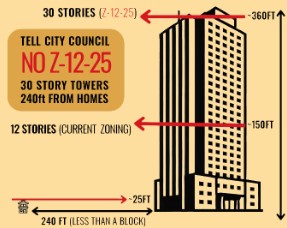
Understanding how Raleigh evaluates rezoning cases is essential to understanding why Z-12-25 is so controversial. The proposal to allow 20- and 30-story towers in a transition area just 240 feet from a historic neighborhood and homes isn’t judged only by whether it meets basic zoning code requirements.
It must also be consistent with the 2030 Comprehensive Plan’s long-term vision, the Unified Development Ordinance’s regulatory standards, and the Capital Boulevard Corridor Study’s location-specific guidance.
When all three layers are applied together—as state law requires—it becomes clear that Z-12-25 conflicts with key height limits, transition requirements, and neighborhood protections built into Raleigh’s planning framework.
How Raleigh Decides on Rezoning Cases
When someone wants to change how a piece of land in Raleigh can be used, like turning a parking lot into an apartment tower or increasing height allotment, they must go through a rezoning process.
Rezoning isn’t just about saying “yes” or “no” to a new project. It’s about making sure any change fits with Raleigh’s long-term vision and the city’s rules for responsible growth.
Raleigh City Staff and Raleigh City Council use three main tools to guide this process.
1. The 2030 Comprehensive Plan (2030CP) – The big-picture vision
2. The Unified Development Ordinance (UDO) – The detailed rulebook
3. Small Area Plans (SAPs) – The zoomed-in view for specific areas of the city
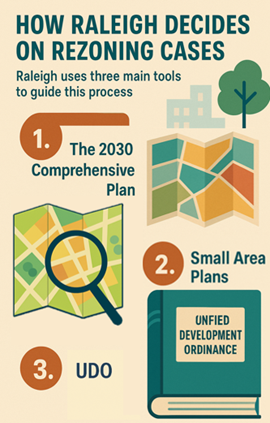
These three tools work together like a map, a rulebook, and a close-up neighborhood guide.
The 2030 Comprehensive Plan – The Big-Picture Vision
The 2030 Comprehensive Plan is Raleigh’s blueprint for the future. It looks decades ahead and answers big questions like:
-
- Where should the city grow?
- How can we protect neighborhoods?
- What’s the best way to add housing and jobs?
- How can we make Raleigh walkable, affordable, and sustainable?
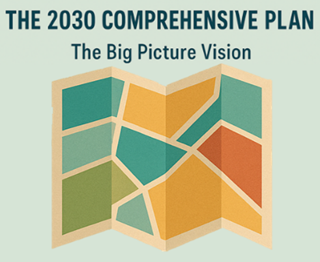
It includes many different tools:
-
- Maps like Future Land Use Maps (FLUM) – shows where different types of buildings and activities should go
- Tables such as Table LU-2 – provides height and density guidance for different areas
- Policies which provide detailed guidance on topics like building near historic areas, gradual changes in height and scale, buffering between different building sizes, transit-oriented areas, and protecting green space to promote walkable and equitable growth.
North Carolina law (N.C.G.S. §160D-605) requires rezonings to be consistent with the 2030CP and Small Area Plans. This means City Council must check if a proposal matches the plan’s maps, policies, and long-term goals, not just whether it’s profitable or popular in the short term.
Z-12-25 is clearly not consistent (2030CP analysis, & Impacts of Cherry-Picking Policy). It cuts across strong guidance from the 2030CP, including more than 40 different policies, 3 core definitions, 2 tables, and many other areas of text, which recommend 3 to12 stories, transitions and protections for neighborhoods and historic resources.
The Unified Development Ordinance – The Detailed Rulebook
The UDO is Raleigh’s zoning code. It is the set of legally enforceable rules that control what can be built in each zoning district. It covers:
-
- The types of buildings allowed (houses, stores, offices, factories, etc.)
- Maximum building heights
- Setbacks (distance from the street or property line)
- Parking requirements
- Design standards for building appearance and transitions
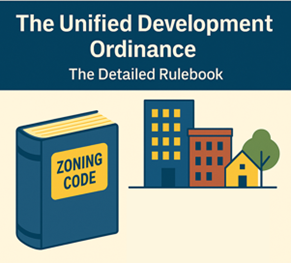
The UDO takes the vision from the 2030CP and creates enforceable regulations that are detailed but not all encompassing of the 2030CP guidance. After a property is rezoned, the UDO dictates exactly what can be built without further City Council approval. While the UDO includes certain rules, like when neighboring zoning districts require setbacks or buffers, the Comp Plan provides a broader, more context-sensitive framework for ensuring compatibility. The UDO does not and cannot account for every situation, especially in sensitive or complex settings like Z-12-25.
The 2030CP policies add important guidance that goes beyond the minimum UDO standards and are critical for preserving the long-term vision and sustainable growth of Raleigh.
While Z-12-25 could be written to match the UDO’s technical zoning categories, under N.C.G.S. §160D-605, rezonings must also be judged for consistency with the 2030CP and Small Area Plans.
Z-12-25 fails this higher-level test.
Small Area Plans (SAPs) – The Zoom-In View
Some parts of Raleigh need extra-detailed planning. That’s where Small Area Plans come in. These plans focus on a specific neighborhood, corridor, or district, adding more detail than the Comp Plan. They may include:
-
- Specific height limits for certain blocks
- Rules for protecting historic areas
- Street designs to improve walkability and safety
- Plans for parks, bike lanes, and public spaces
The Capital Boulevard Corridor Study is one example that provides a vision for the areas surrounding Capital Boulevard north of downtown Raleigh, including the land that is part of Z-12-25.
Once adopted by City Council, SAPs become part of the official policy framework used in rezoning decisions.
Z-12-25 is clearly not consistent with applicable small area plans (Small Area Plan Analysis). It violates the Capital Boulevard Corridor Study (CBCS) guidance for heights (3-12 stories).
How They Work Together
When a rezoning request is reviewed, the city follows this process:
1. Check Policy Consistency – Does Z-12-25 match the 2030CP and relevant small area plan? NO
2. Apply the Regulatory Layer – Does Z-12-25 meet UDO standards? MAYBE
3. Combine Policy and Regulation – Even if a proposal could fit in the UDO, it must still align with the 2030CP bigger vision. Does Z-12-25? NO
4. Think Long Term – Council weighs all three tools to decide if the change supports Raleigh’s future goals, protects neighborhoods, fits its surroundings and does not create far reaching unintended consequences.
Conclusion
By law, rezonings are legislative actions that must be judged for consistency with the 2030CP and SAP, not just technical compliance with the UDO. Many of the Comp Plan’s policies on height, scale, density, and design are not repeated in the UDO, yet remain active and essential in decision-making.
Ignoring these policies would mean disregarding the framework that ensures growth happens responsibly, equitably, and in line with Raleigh’s long-term vision.
In the case of Z-12-25, these three planning tools make it clear why the proposal is problematic.
While the landowners may argue that it meets certain UDO requirements, and some 2030CP polices, the 2030CP and the Capital Boulevard Corridor Study (a Small Area Plan) both provide broader policies and location-specific guidance that limit building heights to 3-12 stories, require strong height transitions, and protect nearby historic neighborhoods.
The proposed 20- and 30-story towers in a transition area just 240 feet from a historic neighborhood and homes are not consistent with the many 2030CP policies, tables, definitions and text sections including height guidance in Table LU-2, and multiple policies on compatibility, buffering, and context (2030CP Analysis).
Under state law, since Council must weigh these higher-level policies over mere technical compliance, Z-12-25 fails Raleigh’s three-layer rezoning test.
Roy Attride, Raleigh Neighbors United
The neighbors support the current zoning which allows for 12 stories.
12 stories IS DENSITY
12 stories provides needed housing
Read more about the West St proposal here: Raleigh Neighbors United
NOTE from Livable Raleigh – Mayor Cowell says she is keeping track of her email on the issue of the proposed 30-story tower at West St. If you are opposed to it and want to see Raleigh honor the Comprehensive Plan as Mayor Cowell said we should, then please email the Mayor and ALL the City Council to express your concerns. This email address will send your message to all council members: citycouncilmembers@raleighnc.gov or you can find complete contact information for each councilor and their social media accounts here: City Council Contacts
Stop Z-12-25 West St Tower – Sign the Petition
Growth with Consequences Risk to Neighborhoods
A Threat to Every Raleigh Neighborhood
Height Without Transition Risks Raleigh’s Future
The Impact of Cherry-Picking Policy – Part One
The Impact of Cherry-Picking Policy – Part Two
The Impact of Cherry-Picking Policy – Part Three
The Impact of Cherry-Picking Policy – Part Four
Is West St in the Core of Downtown?
Do City Plans have a Use By Date?
West St Tower Violates Raleigh Downtown Plan
West St Tower Violates Equitable Transit Development
West St Tower Violates the Capital Blvd Corridor Study
West St Tower Proposal Violates the Comprehensive Plan
West St Tower Neighborhood Meeting – All Stand!
Want to know more about these signs?
If you appreciate the kind of reporting we bring to you
|
Please donate $10 or $20, Thanks for supporting |
 |