
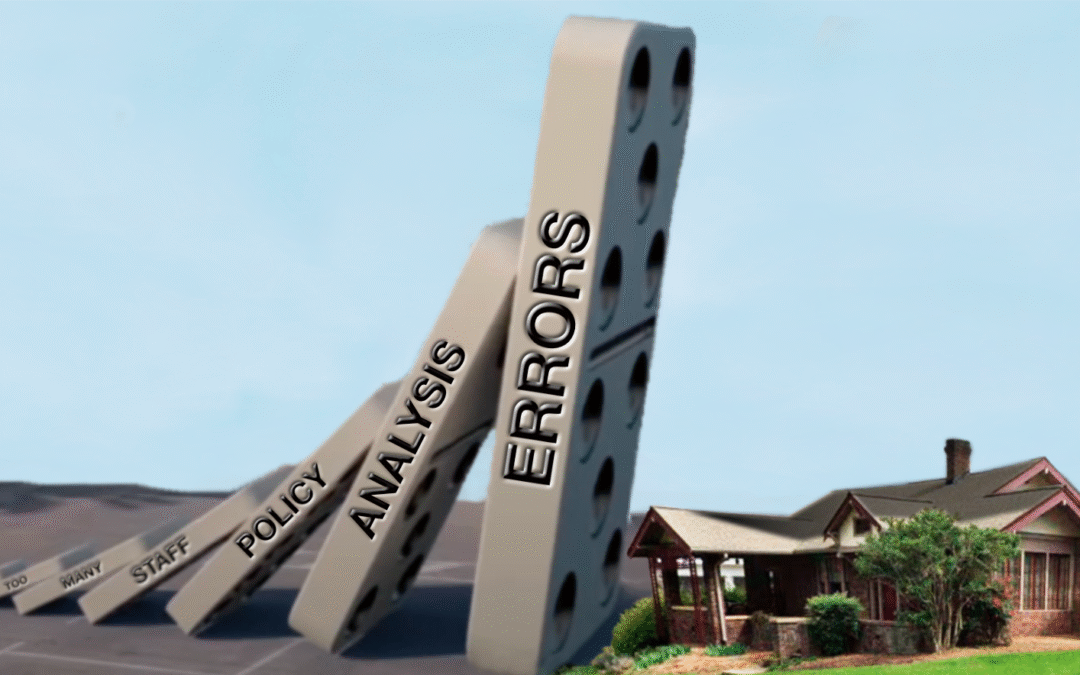
Raleigh’s Planning Staff released a Report for Z-12-25, The West Street Tower, with a Comprehensive Plan Analysis claiming the zoning is consistent with 18 Comprehensive Plan (Comp Plan) policies and not inconsistent with even one.
Z-12-25 asks Raleigh to allow 30 and 25-story towers where current law allows 12-stories.
To come to this conclusion, staff made 4 simple errors. We go through each of those errors, show you the language from city documents that was misinterpreted and give you the updated results.
The differences in the analysis will shock you. After correcting the four errors, we find 28 inconsistent policies where the city found none.
ERROR 1
The definition of the term ADJACENT
The staff report says the Historic Glenwood-Brooklyn Neighborhood (HGBN) is NOT Adjacent to the site to be upzoned
While they use both terms, neither the Comp Plan nor the UDO (Unified Development Ordinance) define the terms Adjacent or Abutting.
City policy requires the use of the common meaning of terms unless they are specifically defined.
The common meaning of Adjacent according to Merriam-Webster is “not distant: Nearby – close at hand“
The common meaning of Abutting according to Merriam-Webster is “to border on: to touch along an edge“
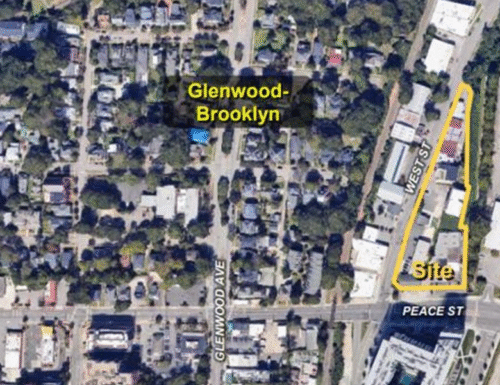
The site is outlined in yellow on the map and HGBN is clearly Nearby to the left separated only by one row of low rise commercial buildings.
The staff report asserts HGBN is not Adjacent to the rezoning site. But, it clearly is based on the common definition of the term.
Staff uses their misinterpretation of Adjacent as meaning Abutting to claim the proposal is consistent with policies DT 1.12 and DT 1.14
If the policy was intended to mean abutting, it would have said abutting.
Since HGBN is Adjacent to the rezoning site, the case is Inconsistent with both policies.
DT 1.12 Downtown Edges: Appropriate transitions in height, scale, and design should be provided between Central Business District land uses and adjacent residential districts.
DT 1.14 Downtown Transition Areas: In areas where the Downtown Section boundaries are located in proximity to established residential neighborhoods, residential densities should taper to be compatible with adjacent development.
The proposed development does NOT include appropriate transitions or taper to be compatible with HGBN. Two years ago staff said this proposal was inconsistent with DT 1.12. Now they claim limiting the northern zone of the property to 25 stories provides adequate transitions. It does not. It provides an abrupt drop from 30 or 25 stories down to 2-story residential homes as little as 190 to 240 feet away. And, the taper from 30 to 25 stories is not toward the homes, it is parallel to the neighborhood. There is nothing protecting the neighborhood from the 30-story tower. Finally, 25 stories is no more appropriate than 30 stories which we will explain in the upcoming section discussing Land Use Recommended Heights.
If you need more proof that the Downtown Transition Policies are intended to apply to HGBN, the policy calls out the Glenwood-Brooklyn neighborhood by name for protection from Central Business District heights.
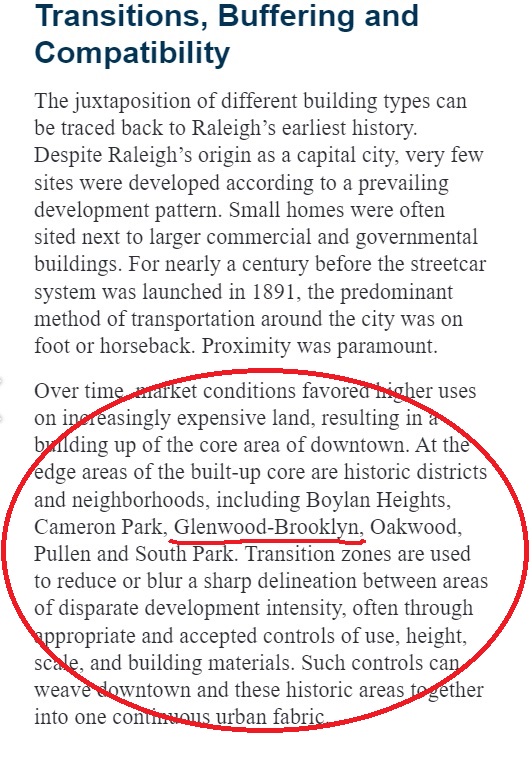
Table LU-2 Recommended Height Designations
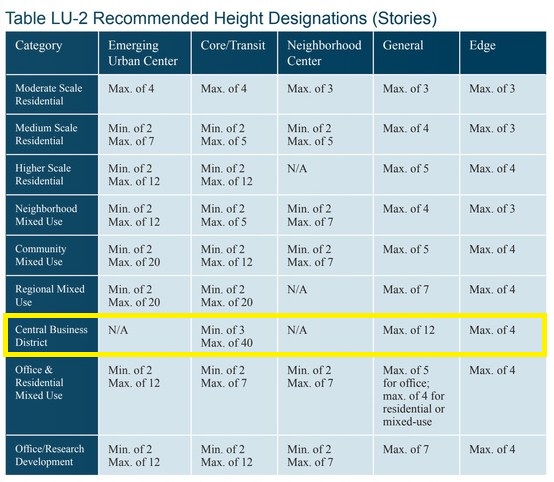
Raleigh uses a Land-Use table (LU-2) to determine appropriate heights based on where the land is located
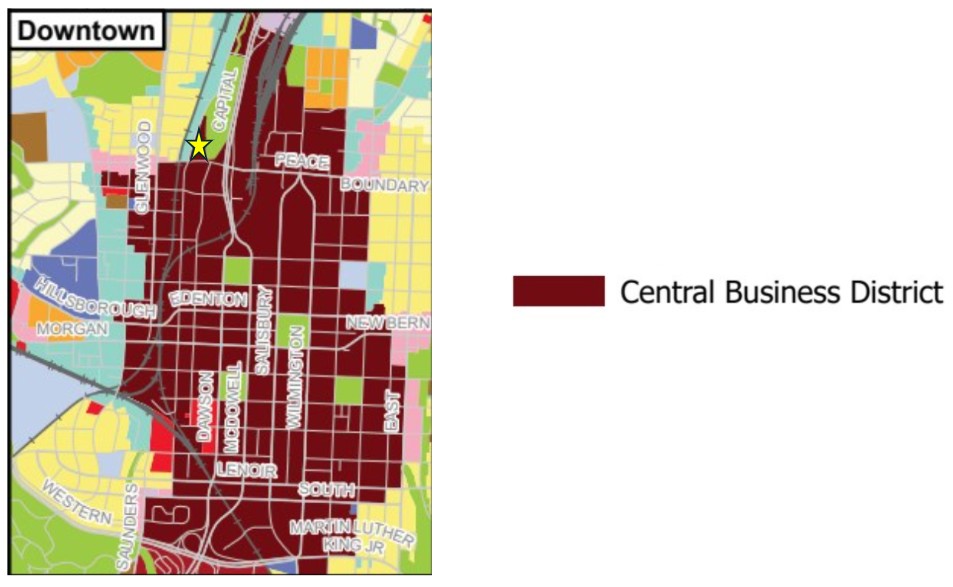
The map to the right shows Raleigh’s Central Business District in red.
The yellow star indicates where the site is located.
The LU-2 table below highlights the row for the Central Business District. There are only 3 possible categories.
The property will be designated as CORE/TRANSIT or GENERAL or EDGE
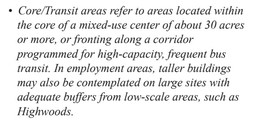
The Comp Plan defines the requirements for a property to be designated as CORE or TRANSIT.
To be designated as CORE a property must be located in the core of a mixed-use center of 30 acres or more
To be designated as TRANSIT a property must front along a corridor programmed for high-capacity, frequent bus transit
ERROR 2
The staff report says the property is designated as CORE
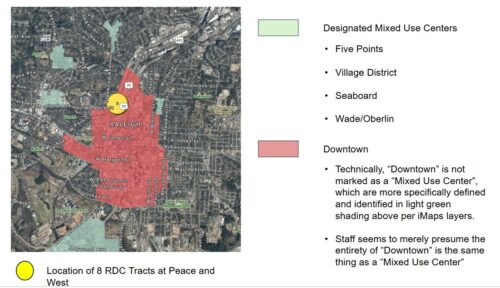
The map shows Mixed-Use Centers in green. The site is in yellow and is NOT located in any Mixed-Use Center. Even if you want to count Downtown Raleigh which is maroon as a Mixed-Use Center, the site is NOT in its core, it is clearly on the fringe.
The site does NOT meet the requirements to be designated as CORE
ERROR 3
The staff report says the property is designated as TRANSIT
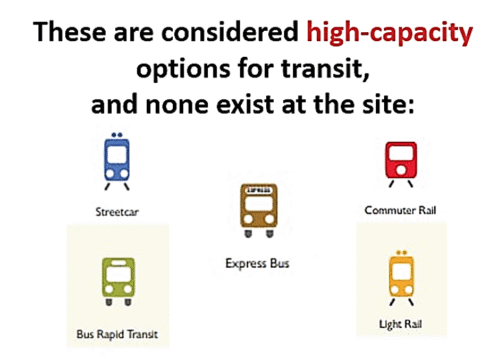
The staff report includes a list of bus routes that serve the site. Only 2 of them actually operate at this property. While one is frequent, NEITHER of them meet the definition of HIGH-CAPACITY (e.g. larger buses, dedicated lanes, enhanced stations).
The definition says “fronting on a corridor”, it does NOT say within 1/4 or 1/2 mile of high-capacity transit.
The site does NOT meet the requirements to be designated as TRANSIT
Since the site is neither CORE nor TRANSIT, the maximum number of stories allowed according to the LU-2 table is 12. 12 stories is the current zoning.
ERROR 4
Because of the 3 errors above, staff neglected to do any analysis of Transition policies
Staff used their erroneous claims that HGBN is not Adjacent to the property and the property is both CORE & TRANSIT to make their next error and assert Transitions, Tapering and Protections for Historic Neighborhoods do not apply. Staff did NOT include any consistency analysis of those policies.
When that analysis is done, there are a multitude of Inconsistent policies to document.
INCONSISTENT POLICIES
After our analysis, this is the list of Inconsistencies we found where staff found NONE
Policies related to Transitions, Tapering and Historic Preservation
Major Policies
Non Major Policies
Other Influencing Policies
CONSISTENT POLICIES
What happened to the 18 policies staff found to be consistent?
Analysis shows these to be Inconsistent
-
- DT 1.12-Downtown Edges
- DT 1.14-Downtown Transitions
- DT 1.16-High Density Development
- LU 4.7-Capitalizing on Transit Access
- LU 4.8-Station Area Land Uses (not a station area)
- LU 4.18-Transit Station Area Recommended Heights (not a station area)
Analysis shows these to be Irrelevant
-
- DT 7.15-Downtown Gateways
- T 5.4-Pedestrian and Bicycle Network Connectivity
- LU 2.6-Zoning and Infrastructure Impacts
These do not promote or require 25/30 stories and are equally consistent with the current 12 story zoning. They do nothing to address or overcome the overwhelming list of inconsistent policies
-
- LU 1.2-Future Land Use Map and Zoning Consistency
- LU 2.2-Compact Development
- LU 2.5-Healthy Communities
- LU 4.5-Connectivity
- LU 11.4-Rezoning/Development of Industrial Areas
- UD 1.10-Frontage
- DT 1.17-High Density Public Realm Amenities
- DT 5.4-Partnership for Parks
- DT 7.12-Plaza/Square Perimeter Uses
Resources
We are not asking that you simply take our word for it. No more than we would simply take the results of the staff report at face value.
Instead, we ask that you not dismiss our findings out of hand without taking some time to review our analysis.
Downtown Transitions, Buffering and Compatibility
The neighbors support the current zoning which allows for 12 stories.
12 stories IS DENSITY
12 stories provides needed housing
Read more about the West St proposal here: Raleigh Neighbors United
NOTE from Livable Raleigh – Mayor Cowell says she is keeping track of her email on the issue of the proposed 30-story tower at West St. If you are opposed to it and want to see Raleigh honor the Comprehensive Plan as Mayor Cowell said we should, then please email the Mayor and ALL the City Council to express your concerns. This email address will send your message to all council members: citycouncilmembers@raleighnc.gov or you can find complete contact information for each councilor and their social media accounts here: City Council Contacts
Stop Z-12-25 West St Tower – Sign the Petition
A Flawed Foundation for Deliberations
Putting Your Thumb on the Scale is Wrong!
Z-12-25 Fails Raleigh’s Three-Layer ReZoning Test
Growth with Consequences Risk to Neighborhoods
A Threat to Every Raleigh Neighborhood
Height Without Transition Risks Raleigh’s Future
The Impact of Cherry-Picking Policy – Part One
The Impact of Cherry-Picking Policy – Part Two
The Impact of Cherry-Picking Policy – Part Three
The Impact of Cherry-Picking Policy – Part Four
Is West St in the Core of Downtown?
Do City Plans have a Use By Date?
West St Tower Violates Raleigh Downtown Plan
West St Tower Violates Equitable Transit Development
West St Tower Violates the Capital Blvd Corridor Study
West St Tower Proposal Violates the Comprehensive Plan
West St Tower Neighborhood Meeting – All Stand!
Want to know more about these signs?
If you appreciate the kind of reporting we bring to you
|
Please donate $10 or $20, Thanks for supporting |
 |