

A Raleigh resident for 34 years and a proud homeowner in the historic Glenwood-Brooklyn neighborhood for 24, Roy Attride has been a dedicated neighborhood leader for many years. With a 22-year career in engineering including more than 7 years as a business leader before transitioning into the nonprofit sector in 2021, Roy Attride brings a balanced, solutions-driven perspective to community advocacy.
Passionate about fostering a successful, vibrant, and growing Raleigh, Roy advocates for thoughtful development that engages neighborhoods, supports smart transit and housing solutions, and ensures growth benefits all of Raleigh—not just a select few. Through Livable Raleigh, Roy shares insights, ideas, and advocacy for a Raleigh that thrives through collaboration, inclusivity, and sustainable progress.
We are reprinting this article from Raleigh Neighbors United (RNU)
Comprehensive Plan in Crisis: Policy Breakdown at the Edge of the CBD
Or
Z-12-25: A Threat to Every Raleigh Neighborhood
Roy Attride (Raleigh Neighbors United)
The 2030 Comprehensive Plan (2030CP) is Raleigh’s long-term policy framework, intended to guide thoughtful, balanced growth through clearly defined goals for land use, development, and neighborhood preservation. But if City Council approves Z-12-25, it would set a precedent that 30-story buildings just 240 feet from homes are not only allowed—but fully consistent with the 2030CP and its policies. This kind of height would no longer be limited to downtown cores; it could be justified adjacent to any neighborhood in the city, including historic ones. The implications of this rezoning extend far beyond one parcel—it could fundamentally alter the future of Raleigh’s planning and development.
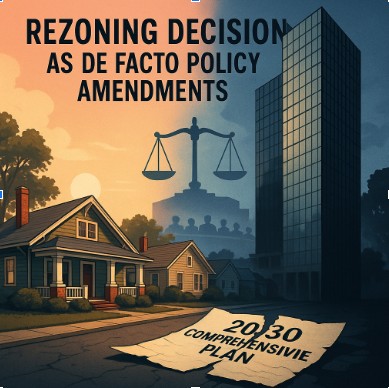
Rezoning Decisions as De Facto Policy Amendments
Under North Carolina law (G.S. 160D-605), when City Council approves a rezoning and adopts a consistency statement—even if the proposal conflicts with adopted plans like Raleigh’s 2030CP—the rezoning is treated as an amendment to that plan. This means the Future Land Use Map (FLUM) and related policies are effectively updated to align with the newly approved zoning. This means that such rezoning decisions do not just apply to a
single parcel, they alter the official policy framework guiding land use and development across the city. In effect, approving 30 stories just 240 feet from homes would make such a configuration consistent with the 2030 Comprehensive Plan, regardless of prior guidance to the contrary.
The 2030 Comprehensive Plan serves as the city’s long-term policy document, outlining goals and policies for growth, development, and land use. Approving this rezoning would override that framework—not through public discussion and thoughtful deliberation or well-developed amendment, but through piecemeal precedent. The impact would ripple beyond this one parcel, effectively altering:
-
- Over 20 adopted policies
- Two official guidance tables (Table LU-2 and Table UD-1)
- Three foundational plan definitions (Central Business District, Land Use Compatibility, and Transitions) See 2030 CP analysis
- The adopted Capital Boulevard Corridor Study, which explicitly recommends heights tapering from 3 stories at neighborhood edges to 12 stories further away.
The City Council would not only be dismantling guidance related to height guidance (Table LU—2 analysis), height transitions, compatibility, and neighborhood protection, but also weakening critical standards around historic resources, corridor planning, and the balance between growth and context. This rezoning could have a devastating effect on the future of Raleigh.
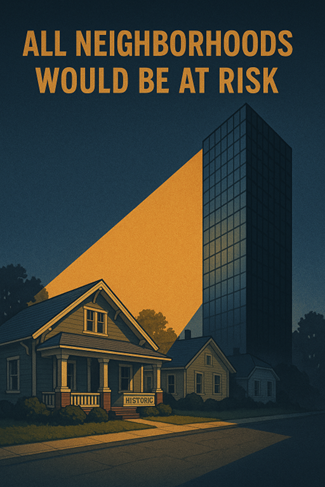
“All neighborhoods would be at risk”
Approving 30 stories just 240 feet from homes, including historic neighborhood, would create a new precedent: that such scale is now consistent with city policy. Any neighborhood in Raleigh would face similar proposals, and there would be no protections. Additionally, City staff and council would have little standing to reject them because they would now be in line with what the 2030 Comprehensive Plan. What was once guidance ensuring balanced growth and transitions becomes irrelevant. The result? No neighborhood in Raleigh would have any meaningful protection against overwhelming, inappropriate height nearby and adjacent to them.
Summary
If the City approves this level of height in a designated Transition Area adjacent to a historic neighborhood, it will effectively rewrite the 2030 Comprehensive Plan—not through public process and thoughtful formal amendment, but by precedent. A 30-story tower just 240 feet from homes would become consistent with adopted plans and policies, making it nearly impossible to deny similar proposals elsewhere. This kind of inappropriate, overwhelming height could then be justified beside any neighborhood in Raleigh, stripping away long-standing protections and eroding the integrity of the city’s planning framework. The consequences would be profound and lasting for Raleigh’s future.
Roy Attride, Raleigh Neighbors United
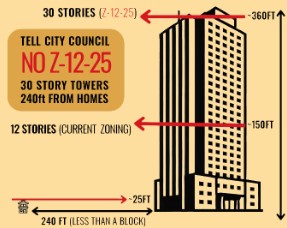
The neighbors support the current zoning which allows for 12 stories.
12 stories IS DENSITY
12 stories provides needed housing
Read more about the West St proposal here: Raleigh Neighbors United
NOTE from Livable Raleigh – Mayor Cowell says she is keeping track of her email on the issue of the proposed 30-story tower at West St. If you are opposed to it and want to see Raleigh honor the Comprehensive Plan as Mayor Cowell said we should, then please email the Mayor and ALL the City Council to express your concerns. This email address will send your message to all council members: citycouncilmembers@raleighnc.gov or you can find complete contact information for each councilor and their social media accounts here: City Council Contacts
Stop Z-12-25 West St Tower – Sign the Petition
Growth with Consequences Risk to Neighborhoods
A Threat to Every Raleigh Neighborhood
Height Without Transition Risks Raleigh’s Future
The Impact of Cherry-Picking Policy – Part One
The Impact of Cherry-Picking Policy – Part Two
The Impact of Cherry-Picking Policy – Part Three
The Impact of Cherry-Picking Policy – Part Four
Is West St in the Core of Downtown?
Do City Plans have a Use By Date?
West St Tower Violates Raleigh Downtown Plan
West St Tower Violates Equitable Transit Development
West St Tower Violates the Capital Blvd Corridor Study
West St Tower Proposal Violates the Comprehensive Plan
West St Tower Neighborhood Meeting – All Stand!
Want to know more about these signs?
If you appreciate the kind of reporting we bring to you
|
Please donate $10 or $20, Thanks for supporting |
 |