

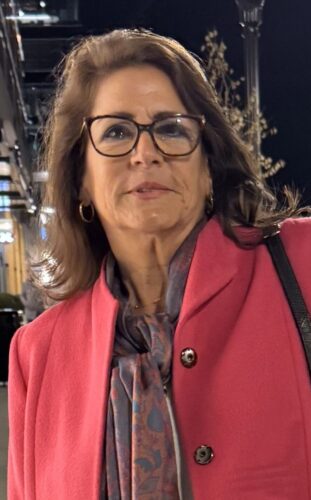
Yolanda Smith, Residential Designer, Builder, and Real Estate consultatnt. With a career spanning over three decades and two continents, Yolanda Smith offers a comprehensive, “full-cycle” approach to the built environment. Born in Peru, Yolanda earned her Bachelor’s degree in Architecture and Engineering Science before relocating to Los Angeles in 1990. Since then, she has operated as a true “one-stop shop” in the industry, mastering the complexities of project management, residential design, construction, and property development. After over a decade of shaping residential and commercial landscapes in Los Angeles and San Diego, she brought her expertise to Raleigh in 2005. Yolanda’s work is driven by a passion for harmonious urban growth. Having been an active participant in the Raleigh 2030 discussion groups and the implementation of the Unified Development Ordinance (UDO), she is a dedicated advocate for development that respects the unique character of established neighborhoods while embracing the city’s future growth.
Yolanda spoke to City Council on May 12, 2026:
Introduction
While 706 Tyler Road is the immediate focus, it serves as a critical case study for the broader risks of applying ‘one-size-fits-all’ Transit-Oriented Development (TOD) overlays without site-specific infrastructure audits.
We must address the fundamental requirements of public safety and statutory compliance.
Under North Carolina Building Code Chapter 11 and the federal Fair Housing Act (FHA), high-density developments are subject to specific mandates regarding accessible connectivity for individuals with mobility impairments.
Permitting a high-density site plan that lacks a code-compliant, accessible route to the public right-of-way creates a significant conflict with these state and federal standards.
The stated goal of TOD is to reduce car dependency. However, there is a physical contradiction in approving extreme density where essential infrastructure—such as sidewalks, lighting, and high-frequency transits are not yet operational. Without these elements, ‘walkability’ remains a theoretical concept, and the city risks permitting developments that are effectively exclusionary to those who cannot safely navigate a narrow, unimproved roadway.
I urge the Council to adopt a case-by-case review process. The City must ensure that density bonuses are only granted where a site can strictly demonstrate it fulfills its legal and functional obligations to provide a safe, accessible environment for the entire community.
May 12 City Council comments
City Council Speech: 706 Tyler Road extreme density – The Case for Case-by-Case Review
Good evening, Mayor and Council members. My name is Yolanda Smith. I am here to discuss 706 Tyler Road in Capitol Heights as a case study of the unintended consequences that occur when blanket transit policy is applied without regard for local infrastructure.
This 7-unit project on a 0.2-acre lot demonstrates a conflict in our current ‘Frequent Transit’ rules. The project occupies nearly every square foot of the parcel, creating a scale that bypasses the very conservation standards established for this neighborhood.
The most critical concern is public safety. Tyler Road is a narrow residential street without sidewalks. Currently, families, strollers, and pets share the roadway with vehicles. By permitting 7 units with zero on-site parking, the project necessitates a significant increase in on-street parking. On a street this narrow, parking on both sides creates a ‘choke point’ that restricts pedestrian movement and, more importantly, threatens emergency vehicle
access. We cannot prioritize maximum square footage over the ability of an EMS truck to reach a home.
While the Planning Department suggests the Transit Overlay ‘unlocks’ this density, the current application creates a technical conflict. Because our NCOD (Neighborhood Conservation Overlay District) addresses lot size, the Infill Compatibility setbacks that protect our streetscape are being bypassed.
I believe this interpretation of the law inadvertently strips away the protection the NCOD was designed to provide. Safety rules and neighborhood standards should remain constant regardless of unit count.
Currently, there is a lack of localized oversight that prioritizes maximum density over the safety of the residents walking on Tyler Road.
I am asking this Council to direct staff to implement a case-by-case evaluation process for TOD projects in established neighborhoods. Density bonuses should be contingent upon:
-
- Infrastructure Alignment: High-frequency transit must be operational on the specific corridor.
- Public Benefit: The project should be legally bound to provide guaranteed affordable housing.
- Safety Verification: A formal safety audit must confirm the street can accommodate both emergency vehicles and safe pedestrian passage.
Raleigh needs smart growth, but blanket policies that ignore physical infrastructure risk displacing the very communities they intend to serve.
Let’s align our zoning with the reality of our streets.
Thank you.
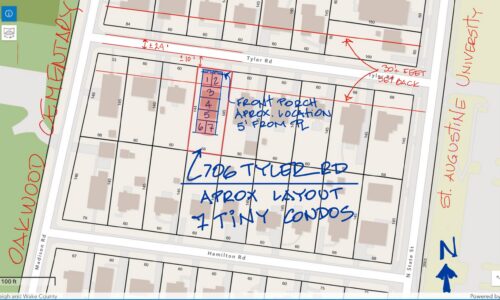
Seven tiny condos crammed into one lot and pushed right to within 5 feet of the street ignoring the current 30 foot setback of the rest of the neighborhood
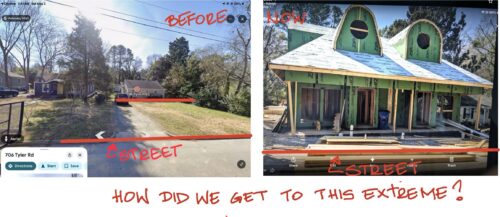
Seven tiny condos crammed into one lot and pushed right to within 5 feet of the street ignoring the current 30 foot setback of the rest of the neighborhood
If you appreciate the kind of reporting we bring to you
|
Please donate $10 or $20, Thanks for supporting |
 |