Stef Mendell has lived in Raleigh since 1964. She is a retired international communications executive and former Raleigh City Council member. She is a founding member of Livable Raleigh (www.livableraleigh.com).
Citizen Engagement Should Be Strengthened, Not Weakened
One of the things that has always made Raleigh special is the active involvement of its residents. Our city has long benefited from citizens who are willing to volunteer their time, share their expertise, and participate in shaping the future of their neighborhoods and our community. That tradition is worth preserving.
During my time on the Raleigh City Council, I worked to expand public access and participation. I led successful efforts to televise Council work sessions and to provide free parking for residents attending meetings at the Municipal Building. Those changes were based on a simple belief: government works best when citizens are informed and engaged.
Citizen engagement is not merely an ideal; it has repeatedly produced positive results for Raleigh. The Hillsborough Street revitalization effort* succeeded because residents, businesses, NC State University, and city leaders worked together to create a shared vision for one of Raleigh’s most important corridors. Today, Hillsborough Street stands as an example of how collaboration and public input can transform a community. Likewise, the vision for Dorothea Dix Park was shaped by thousands of residents and by citizen advocates, including Dix 306, who fought to preserve the entire property as a world-class public park. The park that Raleigh enjoys today is the product of that engagement and shared vision, not top-down decision making.
Unfortunately, since 2020, the City Council has steadily moved in the opposite direction.
The Council withdrew support for Raleigh’s historic Citizen Advisory Councils (CACs), despite their decades-long role in connecting residents with city government. Although Council later voted to restore the CACs, the responsibility for reviving them has largely been left to volunteers, while bureaucratic hurdles make that task unnecessarily difficult. Ironically, critics often characterized CACs as organizations dominated by wealthy white homeowners, yet many of the CACs that became dormant after support was withdrawn served majority-minority communities. For more, read: The Truth about CACs
Meanwhile, the city’s growing Community Engagement Department (CED) should be working in partnership with neighborhood organizations, not treating them as competitors. Even within the CED, the all-volunteer Community Engagement Board, composed of residents from all districts, has been dissolved, leaving engagement to staffers not necessarily representing all areas of Raleigh.
While developers have a formal role in the city with Quarterly Development Stakeholders’ Meetings, opportunities for public participation continue to be reduced or eliminated.
Members of the Stormwater Management Advisory Commission and the Transit Authority—both bodies that include citizen representatives—have been stripped of their ability to provide input on rezoning cases. Public engagement on traffic-calming decisions is being curtailed in favor of leaving those choices largely to staff. Small area plans developed by staff in conjunction with public input are being abandoned. And there are indications that Neighborhood Conservation Overlay Districts (NCODs), which residents worked diligently to establish, may be dismantled without meaningful public involvement.
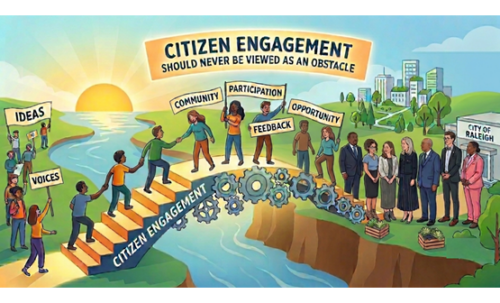
Citizen engagement should never be viewed as an obstacle. Public participation can be time-consuming and sometimes inconvenient, but it produces better decisions and builds trust in government.
Developers and special interests will always have a voice at City Hall. Ordinary residents deserve one as well.
Raleigh’s future should not be determined solely by those with the resources to influence elections or hire lobbyists. The city’s greatest strength has always been its engaged citizens. Rather than weakening that tradition, we should be renewing and strengthening it.
Meaningful public engagement is not a barrier to progress. In fact, some of Raleigh’s greatest successes—from the revitalization of Hillsborough Street to the creation of Dix Park—demonstrate that when citizens are invited to participate, the entire city benefits.
Citizen engagement is not an impediment to good government. It is one of its foundations.
Regards,
Stef Mendell
*Hillsborough Street Revitalization Effort:
The power of quality citizen planning
The five-day stakeholder-based visioning process for Hillsborough Street produced a shared vision for what has become one of the city’s most successful revitalization efforts.
The strength of that revitalization vision led to major city investments in roundabouts, medians, underground utilities, bike lanes, bus improvements and pedestrian crossing improvements. The city’s $20M investment in street improvements has spurred $500M in private investments that have benefited NC State, the surrounding neighborhoods, neighborhood businesses and the city’s tax base – all without creating a wave of teardowns in the neighborhoods or of older businesses.
The success of the Hillsborough Street revitalization was due to the strong participation and buy-in of all the stakeholders, believing in the fairness of the process and the confidence that everyone’s voice would be included in the compromises that defined a truly democratic and successful community vision for West Raleigh that will continue to guide the area’s sustained growth for decades to come.
If you appreciate the kind of reporting we bring to you
|
Please donate $10 or $20, Thanks for supporting |
 |