Strong Towns Commentary by Edward Erfurt
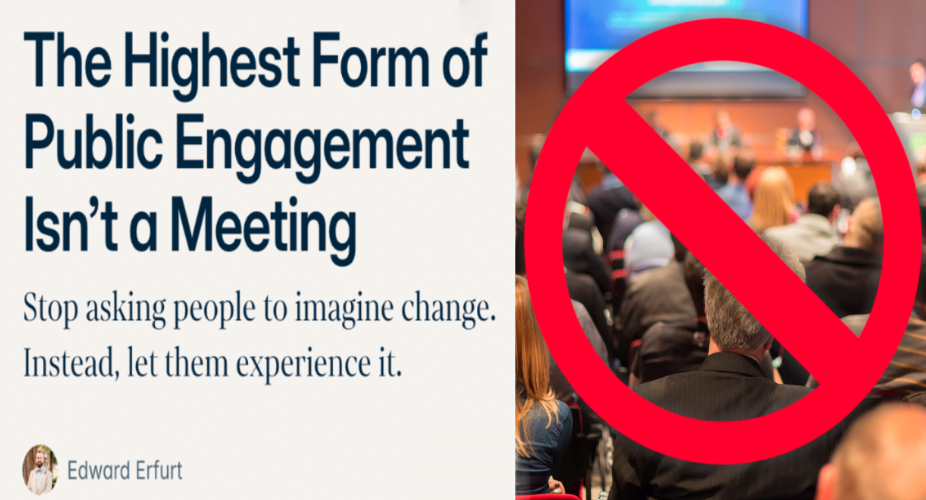
When cities talk about public engagement, they usually mean a meeting.
A conference room at city hall is reserved for a weekday evening. Notices go out in the mail and are posted on the city’s website. Drawings are printed and mounted on foam board and the design team prepares a presentation. Residents are invited to react, offer feedback, and help shape a decision before anything is built.
This process feels orderly. It feels fair because the community is invited to attend. It feels like participation, even when only a handful of people show up.
But it rests on a flawed assumption: that engagement must be completed before action can begin.
And there’s a reason cities cling to this model which has little to do with genuine participation. Public meetings are risk management. They give agencies something to point to later: “The public had every opportunity to provide input,” or, “This design reflects what we heard through our engagement process.” The meeting was never meant to change the outcome. It was meant to protect the decision-maker.
That’s not engagement. That’s preemptive deflection.
And it fails in a very specific way. When engagement is treated as a gate, something to clear before action can begin, we end up asking people to do something genuinely difficult: interpret technical proposals and predict how they will function in real life. We show residents plans, cross-sections, and traffic models. We ask them to evaluate tradeoffs and form opinions about designs they have never experienced.
Even professionals struggle with this. For everyone else, it means translating abstract information into lived reality, and most people don’t think in diagrams or design standards. They think in habits and experiences: how they drive to work, where they cross the street, how their kids get to school.
So the feedback we get is predictable. Cautious. Reactive. It centers on fear of change not because people oppose improvement, but because they genuinely cannot picture what’s being proposed.
We call this engagement. But what is really happening is theater.
Cities can shift from merely theater to meaningful action
Instead of asking residents to imagine how a street might function via large-scale plans or a PowerPoint presentation, cities can show residents quickly, cheaply, and in the real world. Cities can temporarily narrow a lane with cones. They can extend curbs and shorten a crossing with paint. They can transform a center turn lane into a temporary median with simple barriers. These aren’t permanent decisions. They’re tests and very small bets that invite a fundamentally different kind of public participation.
People can engage and provide real-time feedback by driving the street. Walking across it. Navigating it on a bike. They experience the change in context, at real speeds, with real constraints. They don’t need to interpret a drawing because they no longer have to imagine the outcome.
This produces a kind of understanding no meeting can replicate.
Read the full Strong Towns article here: https://www.strongtowns.org/journal/the-highest-form-of-public-engagement-isnt-a-meeting
This article is reproduced here with the express permission of Strong Towns. Strong Towns is a 501(c)3 non-profit organization. Their work is performed under a Creative Commons Attribution-ShareAlike 4.0 International License.
If you appreciate the kind of reporting we bring to you
|
Please donate $10 or $20, Thanks for supporting |
 |