
Jheri Hardaway, also known as Ms. Jheri Worldwide, is a versatile writer, sales professional, educator, and adventurer. Holding degrees from North Carolina A&T State University and Kingston University London, her academic background spans Creative Writing with a focus on Scriptwriting, African American Literature, International Relations, and Post-Colonial Studies, including research on the UN Security Council and the modern-day economics of southern plantations. She is also proficient in French and Spanish.
We are republishing Ms. Hardaway’s editorial from the Carolinian with her permission:
NOTE from Livable Raleigh: The corrupting influence of money in politics has never been greater – at the state level as detailed in this Impact Fee editorial – and in Raleigh. As the November elections approach, Livable Raleigh will again connect the dots between City Council candidate positions and their development industry donations. Read more about Raleigh Impact Fees here, describing Council’s last effort in 2006 to reduce the taxpayer subsidy of growth costs: https://www.wral.com/
NORTH CAROLINA HOME BUILDERS
ASSOCIATION: BUILDING HOUSES AND BUYING POLITICIANS ACROSS THE STATE
By Jheri Hardaway
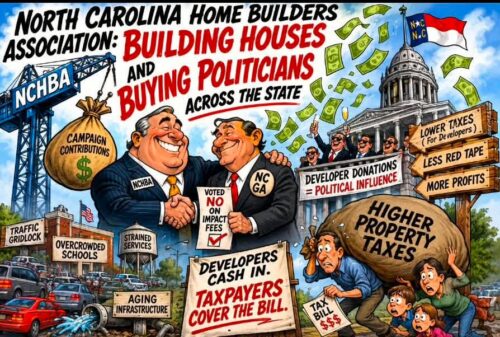
Developer contributions to the North Carolina General Assembly have resulted in policies that have depleted the local government’s ability to tax developers. The results are in, developers and politicians win, while tax-paying citizens hold the bag. When analyzing this Board of Elections data against the political promises of “representing the people,” a stark contradiction emerges: by taking builder money and voting down impact fees (one-time charges on developers to pay for the infrastructure required by new housing growth), these elected officials are directly forcing local counties to raise property taxes on everyday citizens to cover the costs. Impact fees are needed now more than ever. An analysis of how this money shapes tax policy and shifts the financial burden of growth onto local communities highlights several key takeaways.
Many of the top recipients on this list campaign heavily on platforms of fiscal conservatism and keeping taxes low. However, their legislative actions on development fees do the exact opposite for local taxpayers.
Understand that when a new subdivision is built, it creates an immediate need for expanded infrastructure, new schools, wider roads, expanded water and sewer lines, and extra emergency services. If a county cannot charge an impact fee to the developer to offset these costs, the money must come from somewhere else. The only baseline funding mechanism left for counties is the local property tax. We are living the result. Elected officials protect developer profit margins at the state level, while local county commissioners are forced to hike property taxes or issue public debt to pay for the infrastructure the new residents require.
The NCHBA is strategic; they heavily fund the exact positions capable of killing local impact fee legislation before it can even be voted on. The top three gatekeeping recipients are Sen.
Bill Rabon ($47,800), Sen. Phil Berger ($42,600), and Rep. Destin Hall ($34,300). These legislatures hold absolute control over the legislative calendar and committee assignments. If a fast-growing county, for example, Harnett, asks the General Assembly for local authority to implement impact fees, these leaders can ensure the bill dies quietly in committee without a floor vote. This year, during the Harnett County Legislative Luncheon, when a county commissioner asked Rep. Howard Penny about impact fees, he emphasized there was no point in bringing it to the floor.
Rep. Julia Howard ($12,800) serves as Finance Senior Chair and Chair of the House Select Committee on Property Tax Reduction and Reform) directly influencing property tax policy and development in-centives. Meanwhile, figures like Rep. Jeff Zenger ($12,300) are members of the House Select Committee on Property Tax Reduction and Reform and Chair of Housing and Development. Their explicitly stated reasons for receiving funds center on “streamlining permitting” and reducing builder “red tape,”which often translates to stripping local governments of the power to charge developers for infrastructure.
These actions leave the people of North Carolina, particularly in fast-growing areas, with rapidly increasing property taxes and unsustainable infrastructure struggles. The data demonstrates a distinct trend of investing heavily in politicians representing the state’s explosive growth corridor. Because state lawmakers have systematically restricted or voted down local impact fee authority, these exact counties are suffering from overcrowded schools and severe traffic congestion. The builders pocket the profits from the rapid expansion, while long-term residents see their quality of life decline or their tax bills rise to subsidize that growth. Lawmakers can claim they are “pro-business” and against “new fees,” but by depriving county leaders of the ability to charge impact fees, they are ensuring that existing homeowners finance the corporate growth. The money tracked in the North Carolina State Board of Election Campaign Finance database of transactions that committees have received shows exactly who is being paid to keep that system in place.
So what’s next? If you’ve been following politics long enough, you know the likely next strategy is to hide this publicly available information.
Queue the election suppression and relaxed campaign finance requirements.
If you appreciate the kind of reporting we bring to you
|
Please donate $10 or $20, Thanks for supporting |
 |