
Lisa Hughet has lived in Raleigh for nearly 30 years and says “my activism really kicked into high gear during the pandemic. Ironically, coinciding with a new City Council who appears not to have the residents of Raleigh as their highest priority. I’m also active in affordable housing matters and animal rescue.”
Lisa Hughet spoke to Raleigh City Council on June 9, 2026:
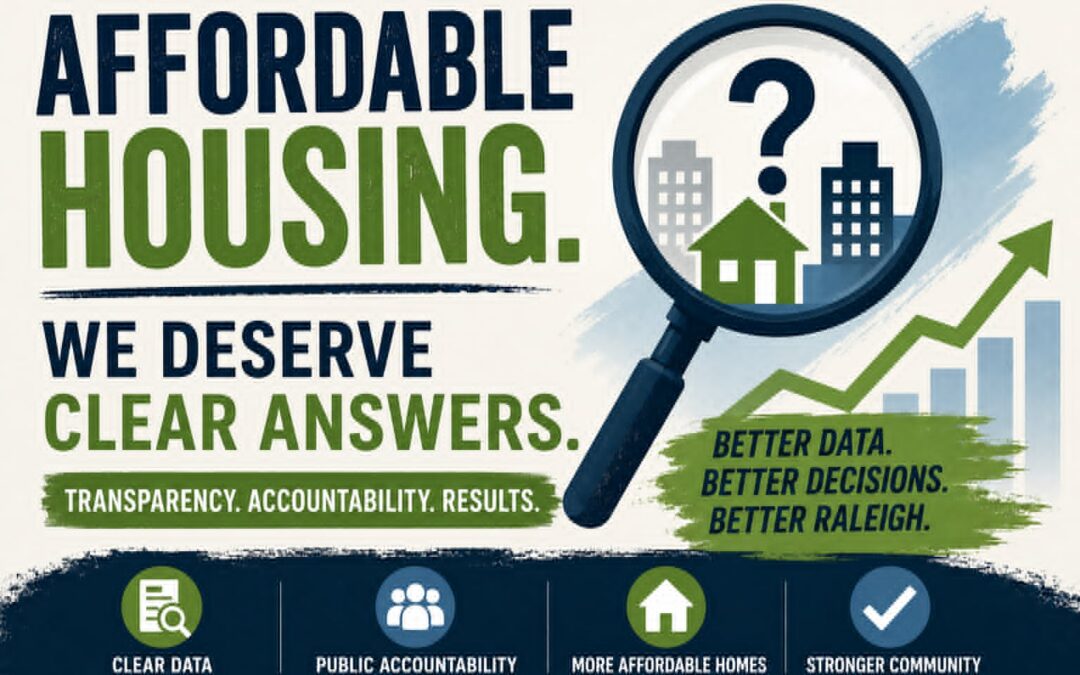
I’m here tonight to talk about affordable housing. My frustration isn’t with the issue itself, but with how difficult it is to find clear metrics on the city’s progress and understand the challenges standing in the way.
I want to be an informed advocate. But I don’t have the time—or the tolerance for frustration—required to constantly monitor Council agendas and sift through meeting materials just to learn what the city is doing. Right now, that’s effectively the only way to stay informed.
There are legitimate reasons affordable housing remains a challenge in Raleigh. Many have been discussed in your meetings: rapid population growth, rising construction costs, reductions in federal funding, and legal constraints.
The research, data, and innovative ideas presented by Ken Bowers, Pat Young and Emma Sutton on these topics are eye-opening. They help residents ask better questions, develop realistic expectations, and contribute meaningfully to the conversation.
The problem is that this information is often buried in work sessions and meeting materials that most residents will never find. Whether intentional or not, the city makes it extraordinarily difficult to access meaningful housing data, understand the barriers to success and evaluate proposed solutions.
Recently, I wanted to know how many affordable housing units the city produced during the current fiscal year. Go to the dashboard, right? Nope. Those numbers are misleading. Metrics such as homebuyer assistance are grouped with housing production, making it impossible to determine the actual number of units created. Ironically, I found housing updates reported by news agencies that were easier to access than information on the city’s own website.
As we approach a new $100 million housing bond referendum, accountability matters. Residents should be able to see – in one place – which projects received funding, how much was invested, how many units were created or preserved and the affordability levels achieved.
After the last housing bond, the city promised transparency. Instead, residents are left with two sparse webpages—one largely explaining what a housing bond is. There is still no simple, public accounting of where the money went or what outcomes it produced.
Can you understand why residents are skeptical?
Affordable housing is difficult enough. Finding information about it shouldn’t be. I have one final request and that is to update the City’s affordable housing rezoning condition.
The current $40,000 contribution was set in 2019. The housing dept now estimates it costs $54,000 to create an affordable unit. The contribution needs to reflect that.
If you appreciate the kind of reporting we bring to you
|
Please donate $10 or $20, Thanks for supporting |
 |