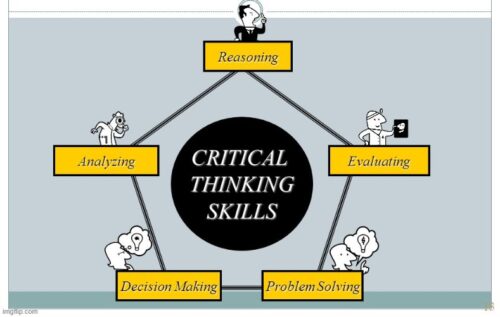
Critical Thinking – definition
The objective analysis and evaluation of information to form a reasoned judgement, involving questioning assumptions, identifying biases, recognizing logical connections, and considering multiple perspectives to reach well-supported conclusions, rather than accepting information at face value. It’s an active, disciplined process of skillful conceptualizing, applying, analyzing, synthesizing, and evaluating information from observation, experience, reasoning, or communication to guide belief and action.
How to judge a rezoning case
When filing a rezoning case, the applicant is asking the city to increase the value of their property. They need to earn that increase in value. Not simply through the absence of harm, but through the presence of measurable benefits to the community. Benefits that are commensurate with the increase in value they are seeking.
Critical listening must lead to critical thinking
This blog is a follow up to a previous blog by Bob Mulder: Critical Listening is KEY. Critical Listening must be followed up with Critical Thinking. We are using the recent North Hills rezoning case, Z-34-25, as our example.
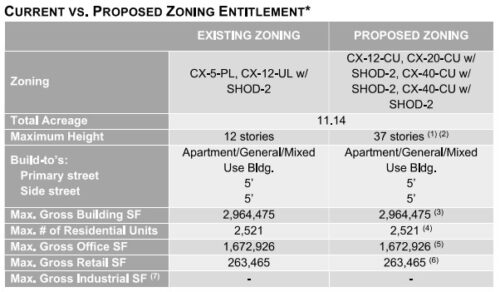
The chart below comes from the Planning Department Rezoning Staff Report which compares the allowable development under the old (existing) zoning column for North Hills to the allowable development under the new (proposed) zoning column. You can see there are NO DIFFERENCES between the two for total square footage, total number of residential units, total office or retail square footage. Anything that can be built under the new zoning could already be built under the existing zoning. The ONLY DIFFERENCE is in the allowable HEIGHTS. It is these increased heights that harm the neighbors and violate the Midtown Area Plan that was unanimously approved by City Council only 5 years ago.
Normally councilors would use the following criteria to judge the merits of a zoning case. As far as the North Hills rezoning case:
Added Housing – this case does NOT add any housing units over what was already allowed. So it doesn’t add any benefit.
Increased Tax Revenue – the case will not generate more tax revenue over the existing zoning. So, there is no added benefit.
Traffic – since this case does NOT add any housing units or more office or retail space to what was already allowed, the case does not add any additional traffic. So there is no harm or benefit.
The community gets NO additional housing, NO additional tax revenue and NO improvement in traffic over what could already be built. Remember, to be approved the proposal must provide a measurable community benefit, not just do no harm over what could already be built. There is no community benefit.
Some Councilors told us they looked deeper into the Midtown Area Plan to find other criteria to judge the case and noted it was a large document, consisting of more than just the height & transition policies that this case violates.
The plan calls for a crossing over I-440 which will need federal funding to build. And to get federal funding, a councilor said we need to “double down” on the area
How does adding NO additional housing, NO additional office space and NO additional retail space over what could already be built double down on anything? It doesn’t! So, again, no community benefit.
The plan calls for serious transit and to get that, a councilor said we need lots of people to live here, work here and go to things here
How does adding NO additional housing and NO additional office or retail space over what could already be built get any more of those things? It doesn’t! So, again, no community benefit.
The plan calls for a waterfront district which a councilor said takes tax revenue
They already acknowledged there will NOT be any increased tax revenue over what could already be built! So again, no community benefit.
None of these criteria support a vote to approve the case because none provide any community benefit.
Councilors went on to praise the developer’s condition to provide 40,000 sq ft of public open space.
But, under scrutiny, it was disclosed the developer is LEGALLY REQUIRED to provide 48,000 sq ft of open space. They will actually provide 60,000 sq ft which is only an additional 12,000 sq ft over the legal requirement. Not the 40,000 sq ft claimed in their added condition. You can’t claim legal requirements as community benefits!
Councilors then expressed their gratitude for the newly added condition to contribute approximately 1 million dollars to the city’s affordable housing fund.
One million dollars is a tiny 1% donation to help finance affordable housing somewhere far away from any Kane development. Not having any affordable housing on-site just means those who work there cannot live there. They will have to commute and contribute to sprawl.
The city’s affordable housing fund is used to pay its part of “gap” financing for LIHTC (Low Income Housing Tax Credits) subsidized low-income housing projects. It is $40,000 per unit. The 1 million dollar donation will cover the city’s portion to fund 25 units to be built somewhere else. 25 units is 1% of the total number of units allowed to be built at North Hills.
It comes down to this. The developer importuned six councilors to cast their votes for a mere 1 million dollars for a project valued at a half BILLION dollars or more.
This is the same way the West Street Tower development was approved. The developer importuned the same six councilors with a small donation to put affordable housing out of their sight.
Measurable Benefits?
Where are the measurable benefits to the community to justify violating both the Comprehensive Plan and the Midtown Small Area Plan that was unanimously approved just 5 years ago after spending countless hours of community engagement and huge amounts of tax dollars to develop it? A plan the residents of North Hills put their trust in and relied on.
If you appreciate the kind of reporting we bring to you
|
Please donate $10 or $20, Thanks for supporting |
 |