A Raleigh resident for 34 years and a proud homeowner in the historic Glenwood-Brooklyn neighborhood for 24, Roy Attride has been a dedicated neighborhood leader for many years. With a 22-year career in engineering including more than 7 years as a business leader before transitioning into the nonprofit sector in 2021, Roy Attride brings a balanced, solutions-driven perspective to community advocacy.
Passionate about fostering a successful, vibrant, and growing Raleigh, Roy advocates for thoughtful development that engages neighborhoods, supports smart transit and housing solutions, and ensures growth benefits all of Raleigh—not just a select few. Through Livable Raleigh, Roy shares insights, ideas, and advocacy for a Raleigh that thrives through collaboration, inclusivity, and sustainable progress.
We are reprinting this article from Raleigh Neighbors United (RNU)
Growth with Consequences:
Capital Boulevard, Z-12-25 and the Risk to Raleigh’s Neighborhoods (Mordecai, Roanoke Park, Georgetown, Mordecai Village and Glenwood-Brooklyn)
Roy Attride (Raleigh Neighbors United)
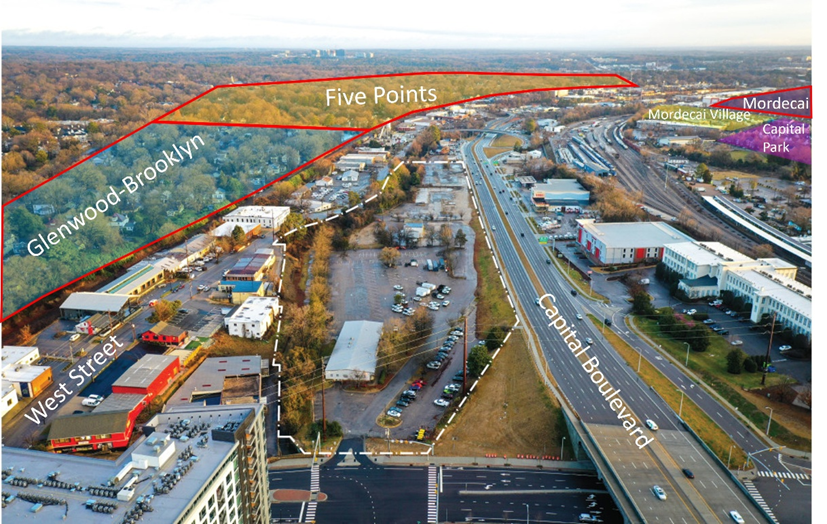
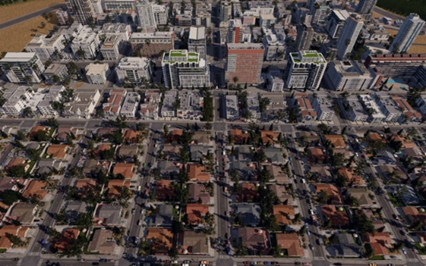
image from the City of Raleigh
Raleigh Neighbors United agrees that Raleigh must increase density beyond current levels, especially in and around downtown, and that we need more housing, including truly affordable options (see article “Why rezoning and building more will not fix affordability”). But growth must be guided by strong policies and thoughtful planning. A diverse urban fabric is essential to create a thriving, inclusive city that works for everyone. That’s why Raleigh developed long-range plans like the 2030 Comprehensive Plan (2030CP) and the Capital Boulevard Corridor Study (CBCS), which include clear guidance on building height, transitions, buffering, density, and protection of neighborhoods and historic resources. These tools are essential to our city’s long-term success.
Given Raleigh’s constraints in expanding housing and density, such as limited land availability, many state-owned parcels, underutilized entitled land, and economic pressures, the Capital Boulevard Corridor represents a key opportunity for thoughtful growth. At the same time, this corridor serves as a major gateway into the city, and any changes will have significant impacts on surrounding neighborhoods, residents, historic assets, green space, and the overall urban fabric. As such, this is a pivotal area for Raleigh’s future, and it is essential that the city approaches it with care, purpose, and a long-term vision that avoids undermining future success.
If City Council approves Z-12-25 — a 30-story, 800-foot-long tower just 240 feet from historic homes in a designated Transition Area adjacent to the Glenwood-Brooklyn Neighborhood (HGBN), a National and City Historic District, it will set a legal and policy precedent that makes this scale of development adjacent to any neighborhood, including historic ones, “consistent” with the city’s Comprehensive Plan (see article Comprehensive Plan in Crisis: Policy Breakdown at the Edge of the CBD). This is not a thoughtful, deliberate, or well-considered decision. It is a short-sighted, reactionary move with sweeping and irreversible consequences. Even with Raleigh’s growth pressures and economic challenges, this kind of reckless action is indefensible.
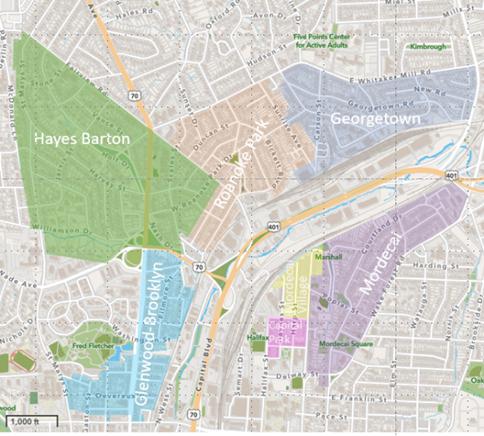
Let’s take a closer look. While every neighborhood would be at risk if this rezoning is approved, several in particular would be more at risk. have similar conditions to HGBN but lack some of their protections. That makes these neighborhoods especially vulnerable to future precedent-driven high-rise rezonings and their detrimental impacts. Impacts include shadowing and loss of sunlight, glare from reflected sunlight, increased noise and light pollution, disruption of neighborhood character and scale, effects on vegetation and mature trees, loss of
privacy, wind tunnel effects and airflow disruption, visual and environmental Impacts. Past Planning Commission Chair Steve Schuster (a well-respected architect, founding partner of Clearscapes, and downtown development pioneer) directly addressed the historic neighborhoods and impact of unmitigated height in the downtown area. “We have multiple national registered historic districts in our downtown, and I think personally to give everyone the right to go maximum height regardless of where they are in downtown is inappropriate when there are other values of our historic properties that would all of the sudden be absolutely devalued. … we have multiple districts that give a lot of character to our community that we do not want to lose.” (January 6, 2015 Planning Commission Working Session on Height at 2:25:01).
The Glenwood-Brooklyn Neighborhood (HGBN) is both a National Historic District and a Raleigh Historic Overlay District. It is bounded on the east by a railroad and then by the Capital Boulevard Corridor. Abutting the railroad right of way is a row of properties zoned IX-3, designated for 3–4 story office and residential mixed use on the Future Land Use Map (FLUM), followed by IX-12, aligned with the Central Business District on the FLUM.
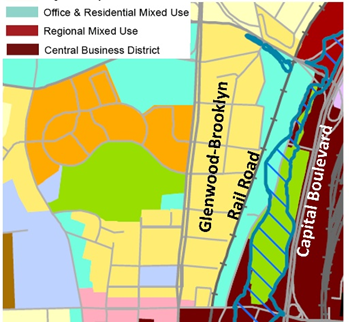
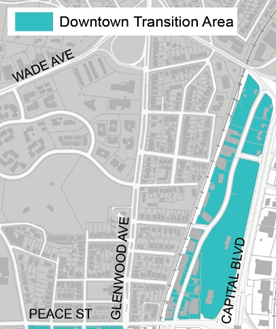
In 2024, a designated Transition Area was established along HGBN’s eastern edge, extending to Capital Boulevard, to ensure additional height and use protections. Between the Capital Boulevard Corridor Study (CBCS), the Transition Area designation, and the 12-story limit prescribed by Table LU-2 of the 2030 Comprehensive Plan for areas with “General” conditions in the Central Business District FLUM, Z-12-25 violates all of these and many more policies (HGBN 2030CP analysis report, HGBN ETOD, CBCS, DP Plans Analysis). If approved, it would render 20- to 30-story towers 240 feet from homes consistent with policy, setting a dangerous precedent.
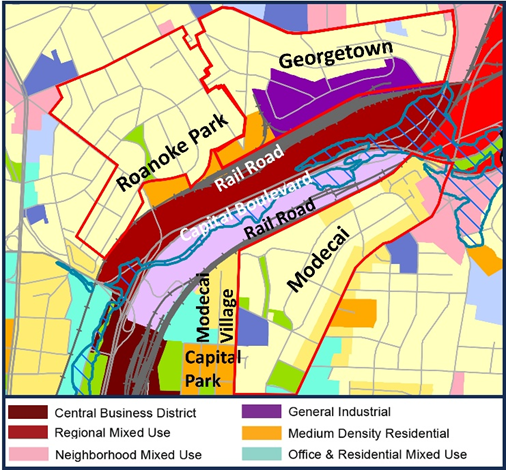
Roanoke Park (part of Five Points) and Mordecai are nationally recognized historic neighborhoods that, like HGBN, are bordered by a railroad and then the Capital Boulevard Corridor. However, unlike HGBN, they are not protected by a Raleigh Historic Overlay District, do not have designated Transition Areas, and lack a buffer of lower-scale (4-story) mixed-use zoning at their edge. Under current policy, both should be protected by the Capital Boulevard Corridor Study (which caps height at 12 stories) and by Table LU-2 of the 2030 Comprehensive Plan, which limits height to
7 stories under “General” conditions in Regional Mixed Use FLUM areas and 4 stories for Neighborhood Mixed use.
If Z-12-25 is approved, despite the clear policies and protections in place for HGBN, these neighborhoods would likely be targeted next and no neighborhood is safe. The limited safeguards for Roanoke Park and Mordecai would be effectively stripped away, opening the door for 20- to 30-story towers just 240 feet from these historic communities.
Georgetown and Mordecai Village are even more vulnerable. They are not designated as national or local historic districts, lack Transition Area protections, and have no buffer of 4-story commercial mixed use along their edges.
Under current policy, both should be protected by the Capital Boulevard Corridor Study, which limits height to 12 stories, and by Table LU-2 of the 2030 Comprehensive Plan, which sets a 7-story maximum for areas with “General” conditions in a Regional Mixed Use FLUM designation and 4-story maximum for Neighborhood Mixed Use.
But if Z-12-25 is approved, despite the clear policies and protections in place for HGBN, the Georgetown and Mordecai Village safeguards would be meaningless, allowing 20- to 30-story towers just 240 feet from these unprotected neighborhoods.
Why does this matter? Pushing building heights to 20–30 stories throughout the Capital Boulevard Corridor would be harmful to both the city and its residents. It contradicts established urban planning principles and goes against Raleigh’s own adopted plans and policies. Height transitions are a foundational principle of smart urban planning, designed to support vibrant, livable cities. These transitions—achieved through building step-backs, gradual shifts in scale and
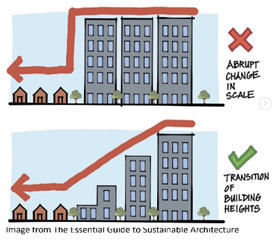
context-sensitive zoning—create human-scale environments that foster walkability, social interaction, sunlight access, and street-level comfort. They reduce glare, mitigate the urban heat island effect, allow for vegetation and airflow, and help maintain visual continuity across the city. These planning practices aren’t just aesthetic; they’re essential to long-term sustainability, public health, and quality of life. In Raleigh, these principles take on even greater importance. Our city’s appeal lies in its diverse, layered urban fabric, which blends neighborhoods, history, and thoughtful growth.
Transitions in height and density help maintain this character while supporting a mix of housing types, affordability, and economic resilience. Raleigh has invested years of work and millions of dollars into carefully crafted plans that balance density, transit, affordability, and neighborhood preservation. To ensure prosperity and livability for all residents, we must honor those plans and stick to sound, sustainable urban planning practices.
Raleigh’s future depends on growth that is not just expansive, but intentional. While we support the need for increased density and more affordable housing, this must be done in alignment with the city’s adopted plans and sound urban planning principles. The 2030 Comprehensive Plan, the Capital Boulevard Corridor Study, and related policies were created to guide this very process—ensuring that growth supports affordability, respects neighborhoods, and protects Raleigh’s historic and cultural identity.
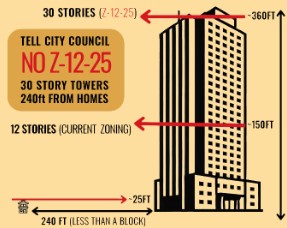
Approving Z-12-25 would ignore these hard-won policies, dismantle critical protections, and set a dangerous precedent for high-rise development adjacent to neighborhoods across the city. It would place short-term interests above long-term success, undermining the thoughtful planning that has made Raleigh livable, walkable, and desirable. We urge the City Council to reject this rezoning and uphold the vision and values that continue to shape a stronger Raleigh for everyone.
Roy Attride, Raleigh Neighbors United
The neighbors support the current zoning which allows for 12 stories.
12 stories IS DENSITY
12 stories provides needed housing
Read more about the West St proposal here: Raleigh Neighbors United
NOTE from Livable Raleigh – Mayor Cowell says she is keeping track of her email on the issue of the proposed 30-story tower at West St. If you are opposed to it and want to see Raleigh honor the Comprehensive Plan as Mayor Cowell said we should, then please email the Mayor and ALL the City Council to express your concerns. This email address will send your message to all council members: citycouncilmembers@raleighnc.gov or you can find complete contact information for each councilor and their social media accounts here: City Council Contacts
Stop Z-12-25 West St Tower – Sign the Petition
Growth with Consequences Risk to Neighborhoods
A Threat to Every Raleigh Neighborhood
Height Without Transition Risks Raleigh’s Future
The Impact of Cherry-Picking Policy – Part One
The Impact of Cherry-Picking Policy – Part Two
The Impact of Cherry-Picking Policy – Part Three
The Impact of Cherry-Picking Policy – Part Four
Is West St in the Core of Downtown?
Do City Plans have a Use By Date?
West St Tower Violates Raleigh Downtown Plan
West St Tower Violates Equitable Transit Development
West St Tower Violates the Capital Blvd Corridor Study
West St Tower Proposal Violates the Comprehensive Plan
West St Tower Neighborhood Meeting – All Stand!
Want to know more about these signs?
If you appreciate the kind of reporting we bring to you
|
Please donate $10 or $20, Thanks for supporting |
 |