“We don’t live in a housing system designed to deliver
affordability through falling prices.”[5]
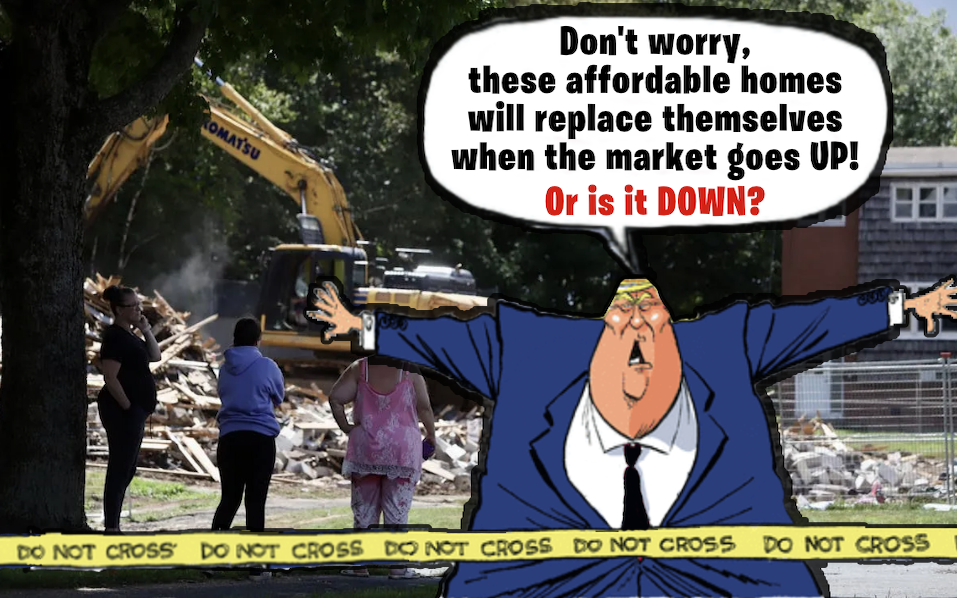
Boosters want us to believe each dip in market-rate home prices will last long enough to filter lower costs down to the households that need shelter most. But that is exactly NOT how our free-market economy works: At the first signs of oversupply the market cuts back financing and production to keep prices high and protect profits.[6]
By the City’s own projections, Raleigh will continue to lose 4,700 affordable units a year[7] while adding only 480[4]. So when boosters like Councilor Lambert-Melton cheer each soft spot in the market as if we are on our way to solving our housing affordability problems[3], it feels like they are hiding the truth, especially when the City’s own Upjohn Institute reference to supply-side affordability backs up the Wake County Affordable Housing Director’s statement that supply-side affordability will take “way too long”[1], likely decades.[8]
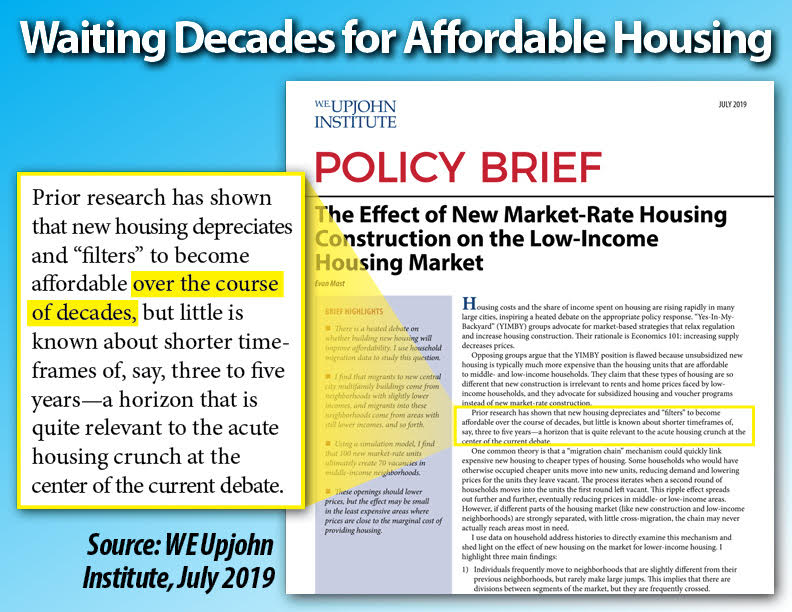
Research cited by City of Raleigh says filter-down affordability will take decades
No one is assigning blame for causing our affordable housing problems, so why not be candid about our very real problems instead of papering over them? For example, tell us how the city will respond to the impending loss of 365 affordable apartment units near North Hills?[9] Where in Raleigh will these 365 households go?
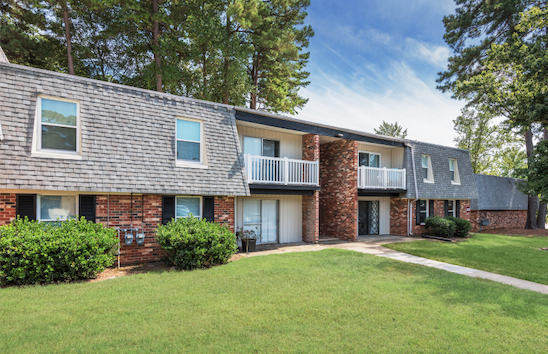
The Pointe at Midtown: 365 affordable apartments will be demolished.
Supply-Side Affordability is a Harmful Fiction[10]
It is time to set aside supply-side affordability theories dismissed by Wake County’s own Affordable Housing Director and many others. Promises of filter-down affordability have produced a backlog of 100,000 unbuilt units and 4,700 affordable units lost each year. Meanwhile, the city is projected to add only 408 affordable units per year over the next five years to serve 51,830 low and moderate income households that are either cost or severely cost burdened.
Let’s move on from self-serving and counterproductive supply-side theories used to justify massive developments that are violating our neighborhoods and our adopted growth plans. Instead, let’s work with Wake County’s Affordable Housing Director toward solutions described in Livable Raleigh’s Affordability Agenda[11], to produce much more affordable housing and more growth according to our adopted plans.
[2] “Concerns about inflation have pushed mortgage rates to their highest level in three months” https://www.nytimes.com/2026/03/20/business/us-economy-oil-prices-inflation-iran-war-americans.html
[3] Councilor Facebook post https://www.facebook.com/share/p/1CE4pzkmmw/
[4] 2026-30 Raleigh-HUD Consolidated Plan https://cityofraleigh0drupal.blob.core.usgovcloudapi.net/drupal-prod/COR19/Final%20ConPlan%20FY%202026-30%20Combined-2.pdf
[5] “For housing to be a good investment, prices must continually rise. … we don’t live in a housing system designed to deliver affordability through falling prices” https://www.strongtowns.org/journal/2026-2-9-the-housing-debate-is-finally-catching-up-to-reality
[6] “High building costs and a glut of supply … have made developers cautious about starting new projects. And permits for new apartments in Raleigh have fallen”. https://www.axios.com/local/raleigh/2026/03/18/raleigh-rents-fell-year-over-year-apartment-construction
[7] Raleigh 2026-30 Affordable Housing Report https://cityofraleigh0drupal.blob.core.usgovcloudapi.net/drupal-prod/COR19/ahp-final-draft-july-2025.pdf
[8] Raleigh-cited Upjohn Institute Report https://drive.google.com/file/d/1vIx7GwIcY58JDIe9-LS4iqkYZgCyTPHs/view?usp=sharing
[9] Kane buys The Pointe at Midtown https://www.multihousingnews.com/kane-realty-pays-72m-for-raleigh-property/
[11] Livable Raleigh’s Affordability Agenda https://drive.google.com/file/d/1T6A0FDf3zWzratsJD5YIW6szoE_klgIC/view
If you appreciate the kind of reporting we bring to you
|
Please donate $10 or $20, Thanks for supporting |
 |