

Another Case of David and Goliath but David is Running Out of Stones
A newsletter from an over the top runway pro development group is so bad and wrong on so many fronts. I did not know that we were keeping score of correspondence to Council or counting the number of people in the audience at the public hearing. All that I know is that the Council Chambers were vacated by half the audience in the room when the hearing was over. Maybe they should issue tickets that designate for or against when people enter the Chamber. This is just a continuation of the labeling and childish antics that one must endure when fighting a rezoning of Kane Realty. One would think they would be comfortable with their presentation being provided with not just one but two law firms, with support from businesses that lease from Kane or are associated with them.
Correspondence from residents is written because they are directly impacted now and may be more so in the future. The letters are not written by older, wealthier defenders of the status quo. They are written by residents that have lived in the area before the development of the North Hills of today or the massive development of North Hills East. Many still live in their original homes built in the Sixties and Seventies, are retired, and are struggling to survive as property values and taxes escalate beyond their means. Yet, there isn’t any affordable housing being constructed, even when the City creates a future Destination site called a Regional Mixed Use Center. Midtown loses more affordable housing on a regular basis as new, more costly housing, condos, and apartments continue to be built.
If Council can take the time to assess whether adding ETJ districts is sustainable for the City, why don’t they apply that same standard to proposed rezonings? The people crafted a Comprehensive Plan and a Midtown Area Plan after considerable community engagement, and both were approved by Council. Why can’t this Council follow them?
There is a lot of talk among Kane supporters and Council about the number of people responding to this case. What many people fail to notice is that many of the responses come from the Kane organization, their affiliates and others that do not live in the impacted neighborhoods. This is common practice when one tries to raise their voices against Kane Realty, as previously noted when the Midtown CAC voted on North Hills East and the room was loaded in the same way to impact the vote. The same was true the first time this came to Council when supporters wore badges that said “Vote Yes”. For an entity like Kane Realty, one would think that such childish behaviors wouldn’t be necessary.
Don’t look now, but compact, mixed-use development is here in the guise of a Regional Mixed Use Center known as North Hills and North Hills East. There is more density per square mile in this area that is only secondary to the massive density of downtown. This area also provides more tax revenue for the City and again is only second to downtown. The difference in this area and downtown is that there isn’t any supporting infrastructure to support it. Surrounding area roads are near capacity and are already forecasted to be over capacity in the next few years. Stormwater control is also inadequate with surrounding areas and downstream areas of the City already experiencing flooding that the City has failed to control since Hurricane Fran. Fire support and rescue are destined to be moved away from the area without a plan or budget for the future. The northern routing of the BRT has already determined that they cannot move more north than North Hills due to road limitations and lack of City funding for Six Forks Road. Yet we have a Regional Mixed Use Center on a Frequent Emphasis Corridor without a bus transfer station or affordable housing for those that may actually need to ride the bus. Kane Realty is providing a conditional donation to the Affordable Housing Fund but leaving it to the City to actually provide that housing. At the high cost of land in North Hills, that donation may assist in land acquisition but is woefully inadequate to actually construct those units at any level of AMI.
The North Hills suburban areas are not sprawl. They are part of the City that all taxpayers support. There is a Midtown area plan and a Comprehensive Plan specifically designed to guide growth in this area. It has been successful to date. Why does this Council and City administration continue to ignore this guidance? What part of government of the people, by the people, and for the people, doesn’t this Council understand? Please listen to the residents that have stood up and spoken up. As elected officials, it is your prime responsibility to support all areas of the City with smart development and infrastructure spending to support it. Follow the guidance that you have been given in both the Midtown area plan and Comprehensive Plan.
By the way, height does not add more tax revenue. The tax is based on the income the building produces. Kane Realty knows this. That is why North Hills Main was expanded with office buildings and a residential building that was consistent with the current 12 and 5-story zoning limits. In addition, they have said that they could build their entitlement within those same heights. Rather than requesting the added heights maximums outlined in the Midtown Area Plan, they decided to ask for buildings in excess of 20 stories that would cause severe environmental impacts on those neighborhoods located directly across the street, without tapering that density down to four stories maximum as recommended in all existing plan guidance. Even the buildings that were constructed in North Hills East were built with height in excess of twenty stories away from existing neighborhoods.
Thank you,
Councilors,
I know that you have received many emails from me, the residents of North Hills, and Mayor McFarlane. All of the emails have carried the same theme: adding buildings greater than the current building heights of 12 and 5 stories will have a devastating environmental impact on the surrounding neighborhoods. Yes, the applicant has the right to build as long as they stay within those building heights. In addition, as noted by Mayor McFarlane, “One of the tenets of the plan is the transition from dense areas to the single-family homes around them. This request does not comply with that. It does not comply with the Small Area Plan.”
As if this is not enough, adding the condition limiting uses for a garage facing Rowan will be a major hardship for the parents of the children that attend Saint Timothy. When they line up to pick up their children, Rowan becomes a one-way street with limited visibility. Does adding a garage opening seem like a safe addition to that neighborhood?
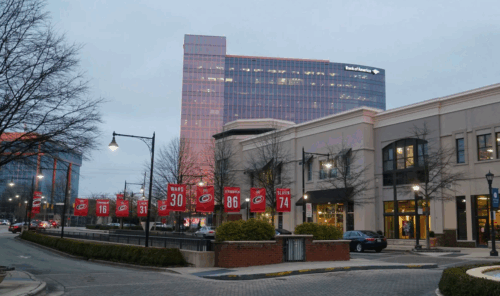
Let me leave you with two things. This is a picture from 2016 when the Bank of America was first completed. It is a view from the circle within North Hills Main. When or if there is a 37-story building added in place of North State Bank, that 20-story building will never be seen again from the interior of North Hills.
Second point,
All residents and City administration do not understand all of the Comprehensive Plan or the Midtown Area Plan. So I asked AI a simple question: “How do you build a simple regional mixed-use center with buildings of different heights? Even AI knows that you don’t add density and height to the perimeter of the complex. Please note the summary!”
Here is the AI response:
Transitioning Building Heights Towards Residential Communities
Transitioning building heights—particularly when introducing taller structures near residential neighborhoods—requires careful planning and design strategies. The goal is to ensure that the new developments integrate smoothly with existing communities while minimizing disruption.
Here are some effective strategies:
Design Strategies for Height Transition
1. Stepped Building Heights
-
- Description: Design taller buildings with a stepped orterraced appearance, gradually decreasing in height as they approach residential areas.
- Benefits: This design creates a more gradual visual transition, reducing the visual impact on nearby homes.
2. Setback Requirements
-
- Description: Implement zoning regulations that mandate setbacks from residential properties, which can reduce the perceived height of buildings.
- Benefits: The additional space can allow for landscaping, buffer zones, or recreational areas that provide a sense of separation.
3. Landscape Buffers
-
- Description: Include trees, shrubs, and green spaces around the base of taller structures to soften the transition.
- Benefits: Natural elements can create a more inviting environment and diminish the starkness of large buildings.
4. Mixed-Use Development
-
- Description: Design buildings with commercial spaces on lower floors and residential units above.
- Benefits: This helps integrate commercial and residential uses while providing amenities and services close to home, blending urban life with community needs.
5. Architectural Design Features
-
- Description: Use architectural features such as varied facade treatments, balconies, and terraces that create visual interest and enhance community aesthetics.
- Benefits: Thoughtful design can mitigate the feeling of looming structures and enhance the overall neighborhood character.
Community Engagement and Feedback
1. Community Workshops and Meetings
-
- Purpose: Conduct workshops to gather input from residents on their concerns and preferences regarding height transitions.
- Outcome: Engaging the community can lead to more acceptable solutions and strengthen relationships between developers and residents.
2. Visual Simulations
-
- Purpose: Use architectural renderings or 3D models to demonstrate how new buildings will integrate with the neighborhood.
- Outcome: Visual tools can help residents better understand projected changes and address concerns early in the planning process.
Regulatory Approaches
1. Zoning Variances and Conditional Approvals
-
- Description: Require developers to obtain variances for height increases, with conditions tied to the improvement of surrounding infrastructure.
- Benefits: This ensures that developments are responsive to local needs and minimizes adverse effects on residential areas.
2. Height and Bulk Restrictions
-
- Description: Establish specific limits on building heights and massing, particularly in close proximity to residential neighborhoods.
- Benefits: Preserves the character of existing communities while allowing for thoughtful urban growth.
Conclusion
Effectively transitioning building heights toward residential communities is essential in fostering harmonious urban development. By employing design strategies, promoting community engagement, and establishing thoughtful regulatory frameworks, cities like Raleigh can ensure that new developments enhance, rather than detract from, the character and quality of life within their neighborhoods.
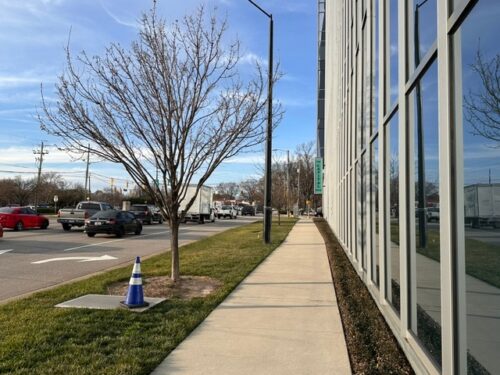
This is the view from the other side of Six Forks at the base of the Bank of America. Does this look attractive?
If you appreciate the kind of reporting we bring to you
|
Please donate $10 or $20, Thanks for supporting |
 |