As it stands, the Dix study would do little more than say to developers, “Keep doing what you’re doing” and the city will help grease the wheels. We don’t need a study for that. The wheels are fully greased. What we do need, and fast, is a thoughtful revision of the study that puts the brakes on pernicious development while it puts in place – in the zoning code and related policies – a strong set of policies to insure that development will henceforth serve the broad public interest, and not just its investors.
FEBRUARY 21, 2023 CITY COUNCIL MEETINGS
HIGHLIGHTS Mayor Baldwin absent from both meetings Work Session provided detailed review about cost of providing City services during annexations Public comments centered on Affordable Housing, gentrification, police accountability, and racial justice Solid Waste...
FEBRUARY 7 CITY COUNCIL MEETING
HIGHLIGHTS Mayor Baldwin and Councilor Melton both absent and excused from afternoon meeting; Mayor Baldwin also absent and excused from evening meeting $50k unanimously approved for Wake Legal Support Center One community center in each District will be made...
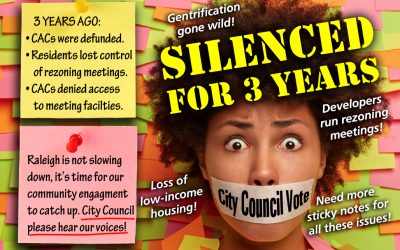
3 Years Ago a Sneak Attack on Raleigh’s Community Engagement System took place: Residents Lost, Developers Won.
Three years ago on February 4, 2020 Mayor Baldwin and her City Council majority voted to stop supporting Raleigh’s Citizen Advisory Councils (CACs). Three years later that void still exists. There are no new community organizations run by Raleigh residents with City support. Fortunately for Raleigh residents there are quite a few Citizen Advisory Councils that survived the sneak attack on February 4, 2020. Even without City funding and support, these survivors have continued on with their mission of two-way communication between Raleigh residents and their City government.
January 24 City Council Meeting Highlights
Most rezoning cases were sent to committee or held for further discussion.
The Density and Growth Dilemma
The false dichotomy that one must be either pro-growth or anti-growth serves no one. A sensible and balanced approach to development would promote growth that is equitable, environmentally sustainable, supported by adequate infrastructure, and compatible with existing development.
Proposals to address Raleigh’s housing crisis
I urge you, as Raleigh’s new city council, to aggressively address Raleigh’s housing crisis. I highly recommend that this City Council genuinely put Raleigh’s residents’ interests above those of the developers.
Can Free Bus Fares Fix Raleigh’s Broken System?
Council’s upcoming decision to either keep or eliminate Raleigh’s COVID-era free bus fares has been framed as making an important statement about Raleigh’s commitment to high quality and equitable bus service. Maybe so, but if you listen to the Raleigh Transit Authority’s Nov 10 deliberations on the topic, you might conclude that reinstating fees will have little impact on a system that is in decline and without an effective plan to provide high quality and equitable transit services in post-COVID Raleigh.
Bob Geary in the Indy: In the Raleigh Elections, I’m Voting for Growth AND Equity. Not Growth Without Equity.
The first camp favors letting the market work without regulation, arguing that it will serve rich and poor alike – but knowing that it won’t – while the second camp favors using the powers of city zoning to assure that growth occurs and serves the interests of all.
October 4 City Council Meetings
HIGHLIGHTS o Southeast Special Area Study referred to Planning Commission. This would potentially involve adding an area larger than the size of the Town of Chapel Hill to Raleigh. Discussion about whether or not Raleigh has the water to accommodate this growth,...