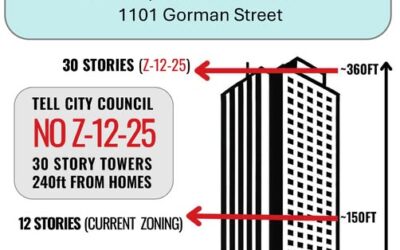
RDC’s claim is that the Z-12-25 site is in a Station Area and qualifies for a Transit designation for height category in Table LU-2, which can allow buildings of up to 40 stories when paired with the Equitable Transit-oriented Development Guidebook (EDAT). But, as of February 2023, the West Street Alternative that included a potential BRT station at West Street and Johnson Street was officially removed from the Northern Corridor plans. The only remaining potential published transit station in the area is now at Lane Street and Capital Boulevard, which is more than a quarter mile away from the Z-12-25 site. With the West Street alignment and potential station now off the table, this site no longer qualifies for a Transit designation nor is it in a Station Area.
2nd neighborhood meeting
I attended the 2nd Neighborhood Meeting for the West Street Tower (Z-12-25). It was strictly limited to one hour and worse yet, the Planning Department’s full report including the Statement of Consistency with city policies was not available. It was a one-sided presentation of the developer’s opinions. The residents had no information from the city to challenge any claims made by the developer.
The Impacts of Cherry-Picking Policy – Part Two
RDC’s claim is, “the Urban Form Map designation for this site is in the Downtown Center,” and that this designation and policies from that section support heights above 12 stories. This is misleading. While it is true that the Urban Form Map UD-1 (UFM) places the site within the Downtown and Core Transit areas, this designation is not a direct basis for determining allowable height or density. it’s important to clarify a potential source of confusion. The site is designated Core Transit on the Urban Form Map but that is not the same as the Core/Transit category referenced in Table LU-2, which is a distinct classification tied to specific definitions
The Impacts of Cherry-Picking Policy
While the developer’s argument relied on selected pieces of the Comprehensive Plan, it reflected a common rezoning tactic: cherry-picking policies to justify a predetermined outcome. But when viewed in full context, the city’s adopted plans and policies provide clear, balanced guidance.
What are Citizens’ Assemblies?
Citizens’ Assemblies are not a silver bullet, but they are a powerful supplement to representative democracy. By fostering informed, inclusive debate, they help bridge the gap between the public and policymakers—and reinvigorate democratic governance for the 21st century.
West Street Tower – Z-12-25 – PACK the ROOM
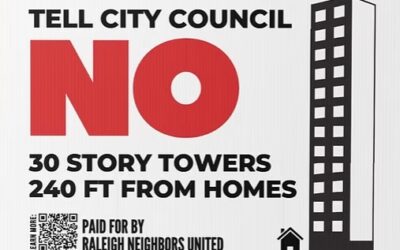
2nd Developer Hosted Neighbors’ Meeting. We need to make ourselves heard. It is about all Raleigh neighborhoods and Raleigh’s Future. This is a BAD project for Raleigh and would set a dangerous precedent that will affect all neighborhoods. Wear RED and PACK the ROOM
Is West St in the Core of Downtown?
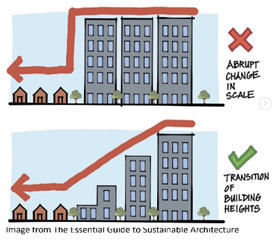
The West St property is NOT in the Core of Downtown. It is defined by the city as being on the edge of the Central Business District and as a designated Transition Area. If you want to build 30 & 40 story buildings, build all of them you want to in the CORE of downtown. Those properties are already zoned for 40 stories and have been for several years.
Do City Plans and Policies have a “Use By” Date?
In the discussion of the 30-story Tower proposed for West Street, a location in a designated Downtown Transition Area, those opposed to the proposal have pointed out that it violates 4 City Plans and 47 policies. In response, those who are supporting the proposal make the claim that those plans are out of date and should be ignored. The plans are NOT OUT OF DATE. Let’s look at the facts.
Why rezoning and building more alone will not fix affordability
Rezoning and adding more housing alone will not solve Raleigh’s affordability challenges. To make meaningful progress rapidly, we need a comprehensive strategy that includes building a diversity of unit types and price points, expanding Naturally Occurring Affordable Housing (NOAH), balancing individual ownership and institutional investment, and incentivizing developers to ensure rezoned projects get built.
West St Tower violates Capital Blvd Corridor Study
The Capital Boulevard Corridor Study (CBCS) is an area plan companion to the Comprehensive Plan. The CBCS specifies the Historic Glenwood/Brooklyn Neighborhood (HGBN) and recommends heights in the study area ranging from three stories at the neighborhood edge, up to twelve stories in areas well separated from neighborhoods. Councilor Silver campaigned on keeping development consistent with our Plans.