Zoning consistency is foundational to confidence in land-use policy

Zoning consistency is foundational to confidence in land-use policy

The King Charles NCOD was adopted to preserve Raleigh’s first planned subdivision east of downtown. Neighborhood Conservation Overlay Districts are legislative commitments. They represent a balancing of growth and preservation through deliberate policy. Their credibility depends on predictability. If an overlay can be removed parcel-by-parcel when redevelopment pressure rises, its long-term stability becomes uncertain.

Raleigh is playing the “We Care” card

Raleigh is playing the “We Care” card

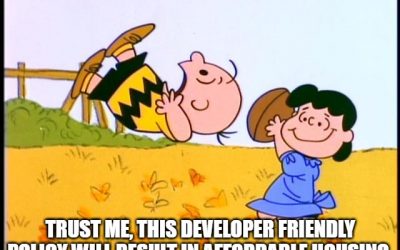
The most devastating loss of affordable housing in the past 20 years has been the city constantly greenlighting the destruction of vast numbers of small brick ranches, duplexes and mom and pop apartment buildings in the older parts of town to give way for McMansions and “luxury” apartment towers.

INCLUDE THE PUBLIC IN THE REZONING PROCESS

INCLUDE THE PUBLIC IN THE REZONING PROCESS

Mary-Ann Baldwin was successful in removing the public from the rezoning process with the elimination of the required meeting held at a relevant CAC. That meeting had a presentation with the applicant, a staff report by a staff member, and time to discuss all of the issues. And the applicant was not in charge. When that process was followed, the public had all of the information needed to make meaningful decisions. Now there is NO process for the public to hear what the staff report says until the Planning Commission meeting. How is the public supposed to participate?

90 to 1

90 to 1

The Citizen Engagement department is nothing but a bureaucracy to separate the citizens from the council. I think that as council members you would WANT to hear from the public. Is there any public accounting of the attendance at Community Engagement department events? If not, why not?

City Staff misrepresented the facts to City Council

City Staff misrepresented the facts to City Council

In the meetings where the Council voted for the 1B West Streamside route, I was amazed at the complete misrepresentation of the FACTS by the Greenway Advisory Committee and the apparent predetermined outcome of this route.

Where Is It?

Where Is It?

The city is FAILING at providing even a fraction of what is needed for Affordable Housing. According to the last breakdown of NET LOSS of Affordable Housing, the city is losing 4,000-5,000 units a year. The Comp Plan and Missing Middle rules are NOT promoting affordability. Instead, the city continues to destroy our existing NOAH to build “luxury” housing.

Council Chooses Bigger Over Better – Again

Council Chooses Bigger Over Better – Again

Does anyone think Kane kicks in extra cash for more height out of the goodness of his heart? The simple business logic is that taller buildings add enormous profits to Kane’s bottom line. It’s just the cost of doing business to offer a small cut of his added profits to get his rezoning approved over the objections of impacted neighbors and conflicts with the community’s Midtown growth plan adopted by Council only a few years ago.

Council has denied ONLY 2 of 54 zoning cases in 2 years

Council has denied ONLY 2 of 54 zoning cases in 2 years

You often point to offered conditions as public benefits. The question is whether those benefits are proportionate to what is being granted. In the recent cases they were not. Doubling or tripling height should come with significantly elevated public benefits. You have leverage. Developers want to build here. Council can either insist on meaningful benefits or adhere to the plans we collectively agreed to follow.

From Critical Listening to Critical Thinking – Councilors must justify their votes

From Critical Listening to Critical Thinking – Councilors must justify their votes

The objective analysis and evaluation of information to form a reasoned judgement, involving questioning assumptions, identifying biases, recognizing logical connections, and considering multiple perspectives to reach well-supported conclusions, rather than accepting information at face value. When filing a rezoning case, the applicant is asking the city to increase the value of their property. They need to earn that increase in value through community benefits.